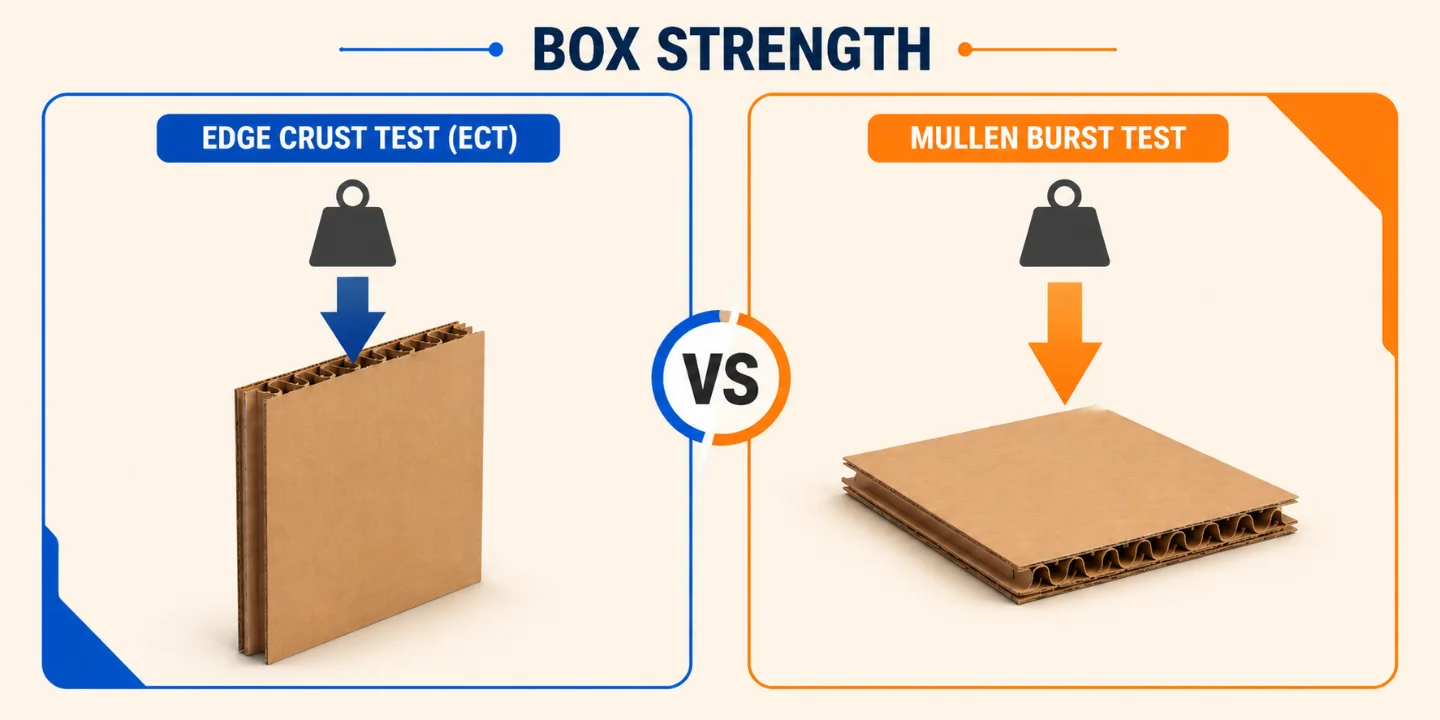
The product that you are proud of is the result of a careful, long process involving labor, the strength of packaging material, and production costs. The question is, will you let your carefully crafted product be in weak and inferior quality packaging? Absolutely Not! You will not compromise on your product packaging if you’re serious about your business. You will definitely discuss certain factors and product details to understand the box strength, especially when the goal is safe shipping.
As a packaging partner, we get a lot of questions about the box strength and how we ensure your product packaging is safe for shipping. Well, for shipping, the most common medium is the corrugated cardboard box. To measure their box strength, we use two main tests: the ECT test and the Mullen Test. People are often confused about how these tests differ from each other when they are intended to measure the box strength.
ECT is the new standard test to determine the corrugated board strength, while the Mullen test is the old test. The Mullen test is not outdated and is even used today to estimate how a package performs during rough handling.
In this blog, we are going to understand box strength via the ECT and Mullen tests. We will discuss the ECT vs. the Mullen Test to see how they are different from each other. Let’s begin!
Why Understanding Box Strength Is Important For Your Product Packaging?
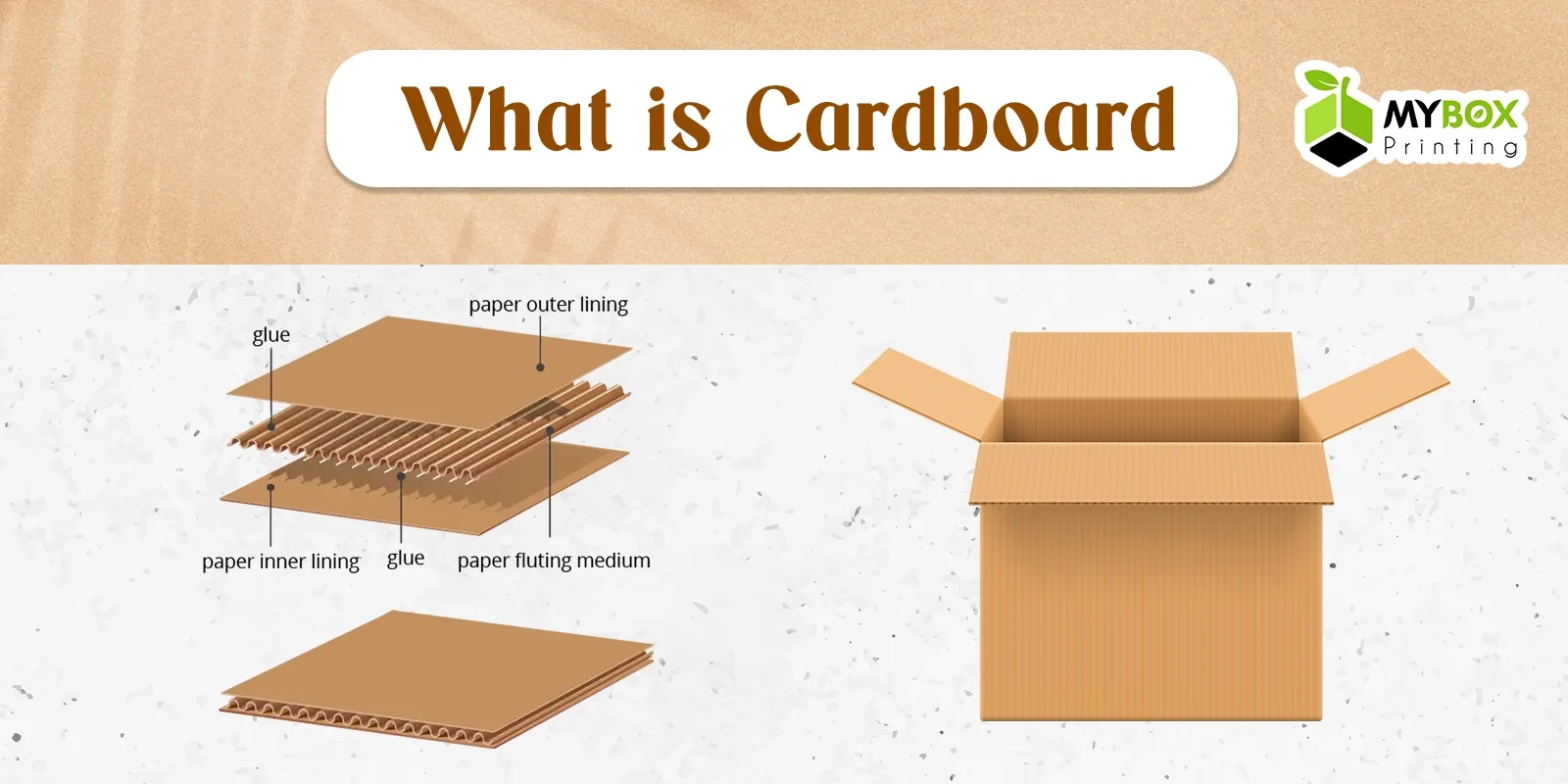
When you have to ship your products, the most affordable and reliable packaging material is corrugated cardboard. But corrugated material is categorized by its wall construction (single, double, or triple wall) and its flute size (such as A, B, C, E, and F), which dictates the thickness and wave density of the inner layers. These elements determine the box's strength; therefore, understanding the box's strength is important.
For Example: If you choose a weak flute for your packaging, your product may collapse during shipping. If you choose unnecessarily strong material, it will cost you additional costs for no reason. The type of product, its weight, and nature, whether it’s fragile or non-fragile.
What Is The Edge Crush Test (ECT)?
The Edge Crush Test (ECT) was developed in 1990 to measure the compression and stacking strength of a box. This test measures the edgewise compressive strength of a corrugated flat board vertically from top to bottom so that the pressure it can withstand before buckling can be determined.
ECT has become a standard test for testing the strength of boxes for shipping and warehouse stacking, especially for small to medium-sized boxes. Many businesses believe that stacking helps in better organization, space, and cost savings, but they face challenges like boxes collapsing. The weight can damage the boxes on the bottom of the pallet. Therefore, they chose the ECT test to determine the stacking strength, as it is directly related to B2B logistics.
The results of this test are measured in lb/in (pounds per lineal inch of the load-bearing edge). This value is termed the ECT value or ECT rating. Common ECT ratings include 32, 44-48 ECT, and 60-90 ECT for single-wall, double-wall, and triple-wall boxes, respectively. Match the ECT rating to your product’s weight and handling conditions because strong edges lead to safe product deliveries.
For Example: A 32 ECT board can withstand 32 pounds of pressure stacked on its edge.
What Is The ECT Grade Board?
The ECT grade board is made of a high percentage of recycled material (can be formed and broken again). This material has shorter fibres and is less interwoven than the Mullen board. The ECT board is less expensive, while it offers a comparable stacking strength.
How Does The ECT Test Work To Determine The Box’s Strength?
ECT itself is a physical lab procedure that involves crushing a small board sample. The packaging engineers use that ECT value as input to estimate the fully assembled box’s strength, which the box can withstand. For this, the engineers use the McKee formula that determines the BCT (Box Compression Test) strength. The formula is:
BCT = 5.87 x ECT x √hx z
Where
BCT: The top-to-bottom compression strength of the finished box
ECT (Edge Crush Test): The edge compression strength of the corrugated board
h (Caliper): The thickness of the corrugated board (inches)
Z (Perimeter): The total perimeter of the box
The ECT is a newer and more accurate test method to measure the box strength. It uses the above-given simplified formula to measure the pounds of force depending on the box outline board thickness.
Technical Specifications
Before you perform the ECT test, you need to understand the following technical specifications of this method:
Measurement: The edge pressure is measured in pounds per lineal inch (lb/in) using this test.
Testing Method: The force of compression is applied until the board bursts.
Box Construction: The light liners are used for the corrugated material as compared to the Mullen board.
Performance: It measures the vertical stacking strength instead of focusing on determining the puncture resistance.
What Are The Potential Benefits Of The ECT Test?
Older is not always better; the same is the case for ECT, which is better than burst tests. It offers potential benefits for businesses by giving them the exact weight they can handle. The potential benefits are given below:
Material Quality
This test helps manufacturers to determine the quality of their cardboard material.
Box Strength
This test enables manufacturers to understand the strength of cardboard boxes and amend them according to their product needs.
Verification Up To Different Burst Strength Levels
It helps you to test box materials up to different burst strength levels to match the shipment requirements. It is also useful when you are concerned with the storage requirements in the warehouse with multiple layers of pallet loads.
Cost Efficiency
The lighter board grades are used in ECT-rated corrugated material, which lowers both packaging and shipping costs.
Sustainability
The board is 10% lighter in overall weight as it supports a lower basis weight. In addition, it uses recycled fibres, so no carbon footprint is produced, which is a green practice.
Carrier Compliance
The ECT-rated corrugated material is manufactured to meet the requirements of major carriers such as Amazon, UPS, and FedEx.
Versatile Use
The corrugated cardboard is suitable for use in different product categories and distribution models.
Corrugated ECT Chart
ECT crush tests determine how much pressure the box’s edges can withstand before they collapse. The corrugated ECT chart is the table that shows the ECT ratings according to the box and how much maximum load or pressure a box can handle. This simplifies the identification of stacking strength for various boxes for shipping, storage, and pallet stacking.
The following tables are based on the official Item 222 (National Motor Freight Classification) and Rule 41 (Uniform Freight Classification) carrier guidelines, followed by standard freight lines. Use the ECT chart given below to choose the right material that supports product safety and cost efficiency without compromising sustainability:
| Corrugated Box Construction Specifications | |||
|---|---|---|---|
| Box Construction | Maximum Load (Weight Limit) | Maximum Outside Dimension (L+W+D) | Edge Crush Test (ECT) Rating |
| Single Wall | 20 lbs | 40 inches | 23 ECT |
| 35 lbs | 50 inches | 26 ECT | |
| 50 lbs | 60 inches | 29 ECT | |
| 65 lbs | 75 inches | 32 ECT | |
| 80 lbs | 85 inches | 40 ECT | |
| 95 lbs | 95 inches | 44 ECT | |
| 120 lbs | 105 inches | 55 ECT | |
| Double Wall | 80 lbs | 85 inches | 42 ECT |
| 100 lbs | 95 inches | 48 ECT | |
| 120 lbs | 105 inches | 51 ECT | |
| 140 lbs | 110 inches | 61 ECT | |
| 160 lbs | 115 inches | 71 ECT | |
| 180 lbs | 120 inches | 82 ECT | |
| Triple Wall | 240 lbs | 110 inches | 67 ECT |
| 300 lbs | 125 inches | 112 ECT | |
Recommendation: We recommend using ECT-rated boxes because they are lightweight but offer the same stacking strength as other materials. In short, you can kill two birds with one stone, i.e., at a budget-friendly price and with a sustainable material.
Types Of ECT Ratings
The most common ECT ratings include 32 ECT, 44 ECT, and 55 ECT or above. Each ECT rating supports different types of product packaging. Let’s learn about different applications of ECT ratings:
32 ECT: Apparel, electronics, accessories, retail products, consumer goods, and e-commerce businesses need lightweight but sturdy packaging material.
44 ECT: Distribution centres need sturdy and heavier material for multi-layered pallets and shipping.
55 ECT or above: For heavy-duty industrial and export shipping, which requires high stacking requirements, 55 ECT or more is used.
Applications Of ECT Test
The ECT test helps you get the perfect packaging material for your products. The common industries that consider the ECT test for evaluating the packaging material:
E-commerce Packaging
The e-commerce businesses use this test to understand the stacking strength of their packaging material. They use this test to choose materials for books, clothes, small electronics, and other items.
Retail Shipments
The retail shipments involve pallet stacking in warehouses. For this, they use the ECT test so that the box strength can be measured to see if it can withstand the weight or not when stored in the warehouse.
Distribution Hubs
In the distribution hubs, these custom boxes have to face vertical compression during storage. So the ECT values let you choose the right material according to your product.
Food and Beverage
The food and beverage industry needs packaging that keeps the food and drinks protected during shipping and transportation. They ensure the packaging is strong enough to withstand the weight of stacking without causing damage to the enclosed products.
What Is The Mullen Test?
The Mullen test is the original test designed prior to the ECT test in 1887 that measures the burst and puncture resistance of the corrugated cardboard. Before ECT, this was the standard test for liner-boards' strength against bursting from internal or external forces. This test also determines how much pressure or weight a box can withstand before rupturing.
This test uses a hydraulic testing device, the Mullen tester, that helps you determine how a package performs during handling in rough situations. They tell you exactly how well it performs under internal forces. They give you an idea of how well a package will perform when many hands interact with the package as it moves from carrier to carrier.
In short, this test is preferred when you are concerned about the box bursting for heavier contents.
What Is The Mullen Grade Board?
Mullen gradeboard is a more robust and durable board than the ECT board. It is designed to be highly durable and is constructed with a layer of virgin fibre. The fibres used in these grade boards are long and interwoven due to the virgin material. This makes it more expensive than ECT.
How Does The Mullen Test Work To Determine The Box’s Strength?
The Mullen or Burst test is performed to certify the strength of the Mullen board. This test involves putting pressure on the flat side of the corrugated sample with the help of hydraulics. The pressure is applied until the sample breaks or bursts. It contains plates that contain circular holes in the middle. The inner machinery applies pressure until the box bursts or a hole is created.
The structural strength of this material is measured in pounds per square inch. 200#, 275#, and 350# are some common measurements, and the higher the unit number goes, the higher the weight it can hold. In short, the higher number shows that corrugated is more durable.
The maximum amount in pounds per inch is measured and recorded once the test is ended. The results help manufacturers to determine the box strength and make improvements.
Technical Specifications
Before testing the box strength using the Mullen Burst test, you must be familiar with the following technical specifications:
Measurement: Burst strength is measured in pounds per square inch (lb/in²).
Testing Method: The test method involves Hydraulic or pneumatic pressure that is applied to the board until it ruptures.
Box Construction: The box is constructed with thicker liners and multiwalls.
Performance: The performance is focused on the determination of puncture resistance and protection instead of stacking strength.
What Are The Potential Benefits Of Mullen Tests?
The Mullen test is designed for the determination of the stacking strength of boxes that contain heavy contents. The following benefits of the Mullen test include:
Regulatory Standards are Met: ECT ensures regulatory standards and rules are met for high-risk shipments such as defence, aerospace, and export packaging. This makes shipping and transportation of these items secure, as they comply with industry standards.
Durability: The Mullen-rated corrugated boxes are puncture-resistant, which prevents them from tearing and bursting under pressure. Whether you stack them on pallets and store them in the warehouse, they do not get damaged.
Protection for Heavy Loads: The Mullen-rated materials offer extra safety and protection to the dense and fragile products. Your products do not get damaged by external pressure.
Long Distance Shipping and Transportation: When you are concerned about the international shipping and handling of your products, the Mullen test gives you better results.
Applications Of Mullen Test
The Mullen-rated boxes are more durable, as they are specially designed for handling packages during long-distance transportation. The common applications of the Mullen test include:
Heavy Machinery and Industrial Equipment Shipments
Mullen-rated boxes ensure better protection against bursting punctures, tearing, and high-impact damage. They use thick liners and multi-wall boxes so that the heavy machinery does not get damaged due to external pressure or collision.
Defence and Aerospace Components
The defence and aerospace components are sensitive, so they need packaging that protects them from external impact. The Mullen-rated boxes keep this equipment more secure during transport.
Agricultural Products and Large Tools
Agricultural products and large tools need heavy-duty shipping boxes that can withstand their weight. The burst test lets you choose the right box according to the strength it needs.
Export Packaging
The Mullen test helps you determine the box strength for items that need to be exported internationally or country-wide. The estimated box strength reduces the chances of damage during long-distance transport.
Mullen Test Chart
The Mullen test chart gives you a quick reference to the maximum bursting strength or burst strength of corrugated boxes. It lets you estimate the maximum load the box can withstand until it ruptures during long-distance and heavy shipments.
This chart ensures that during export, industrial, and high-risk applications, your products remain safe.
| Corrugated Box Construction Specifications (Mullen Test) | |||
|---|---|---|---|
| Box Construction | Maximum Load (Weight Limit) | Maximum Outside Dimension (L+W+D) | Mullen Burst Test Rating |
| Single Wall | 20 lbs | 40 inches | 125# |
| 35 lbs | 50 inches | 150# | |
| 50 lbs | 60 inches | 175# | |
| 65 lbs | 75 inches | 200# | |
| 80 lbs | 85 inches | 250# | |
| 90 lbs | 95 inches | 275# | |
| 120 lbs | 105 inches | 350# | |
| Double Wall | 80 lbs | 85 inches | 200# |
| 100 lbs | 95 inches | 275# | |
| 120 lbs | 105 inches | 350# | |
| 140 lbs | 110 inches | 400# | |
| 160 lbs | 115 inches | 500# | |
| 180 lbs | 120 inches | 600# | |
| Triple Wall | 240 lbs | 110 inches | 700# |
| 300 lbs | 125 inches | 1300# | |
Recommendation: We recommend that you pair the double-wall Mullen-rated boxes with plastic strapping, bubble wrap, steel strapping, and strapping machines for bundling. This makes sure your package remains secure during long-distance transportation.
Types Of Mullen Ratings
For different packaging and shipping needs, different Mullen ratings are assigned. The most common Mullen ratings used for durable boxes are listed below:
200# Mullen: This Mullen rating is used for medium-duty shipments such as packaged tools, consumer products, and appliances.
275# Mullen: This burst test rating is used for the shipment of heavier or fragile items, including industrial equipment, sensitive machinery, and components.
350# Mullen & above: This value is used when you need boxes for exporting high-risk items that need maximum protection.
Key Differences: ECT vs Mullen Test
The two standard tests that measure the stacking strength of corrugated boxes are the Mullen and the ECT tests. The Mullen test is older and is supposed to measure the burst strength of corrugated boxes. On the other hand, ECT focuses on measuring the stacking strength of the box.
Both tests are effective, but in different scenarios. The standard test to measure the strength of corrugated material is the ECT. It is so because it requires 10% less material than traditional Mullen-rated boxes. This saves shipping and packaging costs. Let’s compare both tests to help you understand which one is better for you:
| Edge Crush Test vs Mullen Test | ||
|---|---|---|
| Feature | Edge Crush Test | Mullen Test |
| What does it measure? | The Edge Crush test measures the stacking or vertical strength of the box that it can bear before collapsing. | The Mullen test measures the bursting strength or puncture resistance of the box until it bursts. |
| Testing Method | The force is applied along the board edge until it fails. | In the Mullen test, hydraulics or pneumatics are applied to measure the bursting strength of the board. |
| Strength | Excellent for estimating the stacking strength of the box, which helps you protect your products against vertical compression. | Excellent test to measure the puncture resistance of packaging for heavy and fragile products that need extra protection. |
| Construction | The ECT corrugated uses light and single or double-walled boards. | The Mullen board uses thick boards constructed with multiple walls for fragile and heavy-duty products. |
| Protection | This test ensures the packaging material is strong enough to protect products against load shifting and minor impacts. | This test makes sure the packaging material is durable enough to shield your product against punctures and heavy stress handling. |
| Cost | ECT is more budget-friendly as it needs 10% lighter liners. | The Mullen test is expensive as it uses thick and multi-wall boards. |
| Industrial Application | This test is useful for retail, logistics, and distribution. In addition, it is used in warehousing, medium/light products, and palletized shipments. | This test is suitable for heavy industry, high-risk shipping, and defense. The prominent industries include heavy-duty shipping, machinery, defense, and aerospace. |
| Sustainability | This test is considered eco-friendly as it uses less material. | Mullen test is less sustainable and eco-friendly. |
Mullen Burst Test vs Edge Crush Test Graph
The Mullen test involves force applied until it creates a hole. On the other hand, in the edge crush test, vertical compression is involved along the edge of containers. Refer to the following table to compare Mullen force ratings to ECT force ratings:
| Mullen vs ECT Ratings by Box Construction | ||
|---|---|---|
| Wall Type | Mullen Rating (inch-oz per inch of tear) |
ECT Rating (pounds per inch width) |
| Single Wall | 125 | 23 |
| 150 | 26 | |
| 175 | 29 | |
| 200 | 32 | |
| 250 | 40 | |
| 275 | 44 | |
| 350 | 55 | |
| Double Wall | 200 | 42 |
| 275 | 48 | |
| 350 | 51 | |
| 400 | 61 | |
| 500 | 71 | |
| 600 | 82 | |
| Triple Wall | 700 | 67 |
| 900 | 80 | |
| 1100 | 90 | |
| 1300 | 112 | |
ECT vs Mullen Test Ratings Chart
The boxes perform differently for different shipping requirements. ECT-rated boxes are more durable in terms of stacking strength, while Mullen-rated boxes are highly burst-resistant and puncture-resistant. You can use the ECT-rated corrugated for heavy pallet loads and warehouse storage.
Find the load capacities and ratings for single, double, and triple-wall boxes in the following chart. This will help industries optimize material use and costs, in addition to enhancing the protection of your products.
| Box Construction Specifications | |||
|---|---|---|---|
| Box Construction | Maximum Load (Weight Limit) | Mullen Burst Rating | Edge Crush Test (ECT) |
| Single Wall | 20 lbs | 125# | 23 ECT |
| 35 lbs | 150# | 26 ECT | |
| 50 lbs | 175# | 29 ECT | |
| 65 lbs | 200# | 32 ECT | |
| 80 lbs | 250# | 40 ECT | |
| 95 lbs | 275# | 44 ECT | |
| 120 lbs | 350# | 55 ECT | |
| Double Wall | 80 lbs | 200# | 42 ECT |
| 100 lbs | 275# | 48 ECT | |
| 120 lbs | 350# | 51 ECT | |
| 140 lbs | 400# | 61 ECT | |
| 160 lbs | 500# | 71 ECT | |
| 180 lbs | 600# | 82 ECT | |
| Triple Wall | 240 lbs | 700# | 67 ECT |
| 300 lbs | 1300# | 112 ECT | |
After comparing the load capacities and strengths accurately, you can make the best decision.
How To Choose The Right Test: ECT vs Mullen?
Whether you choose the ECT or the Mullen test, you need to understand what your needs are. It simply depends on balancing product weight, shipment risk, handling environment, and budget. If your concern is to save costs without compromising the stacking strength, you can choose the ECT test. It uses less material while giving you accurate results.
If you are thinking that the Mullen test is an old test and old is gold, that’s not true in all scenarios. The Mullen test is expensive, as it uses thicker materials, and is excellent for international and long-distance transportation. ECT is the new standard, but it cannot be the universal certification for all scenarios.
If you want to safeguard your products from being crushed during transit, you must choose the ECT-rated boxes. But Mullen-certified boxes must be your choice if you want your packaging to withstand rough handling.
When To Use: The ECT Test vs The Mullen Test
ECT and Mullen tests perform excellently when chosen for the right use cases, i.e., the company’s needs and the type of products. Before you choose either of these tests, ask yourself a few questions that will lead to the right test:
+ Will you need to stack boxes on top of each other during storage and palleting?
+ How much weight will the bottom row of stacked boxes have to withstand?
+ Will the boxes be shipped together or individually?
+ What is the weight and nature of the item? Is the item brittle or fragile?
+ What protection measures are taken inside the box to ensure extra protection?
+ Under what circumstances will the box operations be handled?
The following table helps you to understand under what circumstances you need to choose the ECT and Mullen test:
| When to Choose Edge Crush Test vs Mullen Test | |
|---|---|
| Use Case | Which Test to Choose? |
| Reliable stacking strength for pallets in distribution centres and warehouses | Use Edge Crush Test |
| Shipment of heavy machinery, industrial tools, and fragile export products | Mullen Test |
| To handle apparel, books, or small electronics and other lightweight or uniform products | Use Edge Crush Test |
| Puncture and burst-resistant packaging for long-distance transportation | Mullen Test |
| Domestic shipping and handling in controlled environments | Use Edge Crush Test |
| International and export shipping, rough handling | Mullen Test |
| Saving cost and material are your priorities | Use Edge Crush Test |
| Extra durability, irrespective of the high cost | Use Mullen Test |
| Basic protection from external impacts and vertical compression | Edge Crush Test |
| Industrial, aerospace, defense, and export packaging applications | Mullen Test |
| Standard logistics operations and retail distribution | Edge Crush Test |
| Combine boxes with standard carton sealing, carton sealing tapes, or plastic strapping | Edge Crush Test |
Frequently Asked Questions
What does 32 ECT mean in corrugated packaging?
The ECT value indicates that the flat sample of corrugated board can withstand the weight of pounds per inch on its edge. So, a 32 ECT value means that the box is capable of withstanding the weight of 32 pounds per lineal inch without getting crushed. According to carrier standards, a 32 ECT pre-assembled single-wall box can carry a maximum load of 65 lbs. This value is used for retail and e-commerce shipping boxes.
Can I convert ECT values to Mullen ratings?
No, you can't. Both tests are intended to measure different performance factors, so there is no direct conversion between them. ECT measures the stacking strength, while the Mullen test measures the bursting strength of the box. Anyhow, the carrier regulations (Rule 41) consider them equivalent based on their weight or load capacities. A 32 ECT and 200# Mullen boxes can carry a load of 65 lbs.
Which is more cost-effective: ECT or Mullen?
ECT is more cost-effective as this test uses liners with a lower basis weight, which makes 10% lighter than the overall weight of the Mullen test to give accurate results. It uses light linerboards that reduce the shipping cost.
Do e-commerce companies prefer ECT or Mullen?
E-commerce companies like Amazon prefer ECT boxes over Mullen because their concern is to estimate the stacking strength of boxes. They want their products to reach the perfect condition at their customers' doorsteps. The 32 ECT is the standard for their shipping boxes, which ensures products are safe.
Is Mullen testing still relevant today?
Yes, Mullen testing is still used by businesses that need to handle exports and international shipping. It is still in use, especially for high-risk shipments such as defense, aerospace, and export shipping. In these sectors, the risk of puncturing a hole by heavy or dense products is greater, especially during rough handling. In these use cases, puncture and burst resistance matter most.
What ECT value boxes are the most common and universal?
The most common and universal boxes used today are 32 ECT. 32 ECT boxes are used for general shipping by retail and e-commerce businesses, as it offers the best balance between weight, cost, and stacking strength.
Final Verdict: Which Test to Use?
Both tests give accurate results when used for the right purpose. If you want your products to be delivered or shipped safely without being crushed, ECT-rated boxes are the best choice. These boxes are durable enough to withstand vertical stacking in warehouses and handle light-to-medium products. When these boxes are combined with protective paper rolls, carton sealing tapes, and stretch films.
On the other hand, Mullen-rated boxes are recommended for high-risk shipments such as exports and international shipping. In these use cases, the boxes need burst protection so you can enhance their security with plastic strapping or steel strapping.
In short, for lightweight to medium-weight products, go for the ECT test. If you have to deal with international shipping, the Mullen test is for you.
If you still have a question or are getting confused about which one is better box strength test and which one you have to choose ECT test and Mullen test, do not waste your time. Pick up your phone, call us, or contact us by pressing the button below to get a free consultation. We are always here for you!