
The packaging material you choose defines your brand's identity, protects your products, and impacts your bottom line. This guide breaks down every difference — so you choose right the first time.
As a business, you experiment with different packaging materials that meet the needs of your products. The wrong choice of box material wastes money and puts your brand's reputation at stake by frustrating customers with inferior quality packaging.
There's one common mistake businesses make: they consider cardboard as the only packaging material when other options exist. Another mistake is treating cardboard and corrugated fiberboard as the same material — they are different, designed for different purposes.
In this guide, we compare the top three box materials: cardboard, corrugated fiberboard, and rigid material — covering their construction, key characteristics, and uses.
A foundational overview of each packaging material before diving deeper.
| Properties | Rigid | Corrugated | Cardboard |
|---|---|---|---|
| Key Characteristics | Non-bendable and sturdy material | Triple-layer fluted material with cardboard and inner flutes | Durable and affordable paperboard material |
| Thickness Options | 1.5 mm to 6 mm | 3 mm to 15 mm | 0.5 mm to 2 mm |
| Weight Capacity | 15–50 lbs | 10–80 lbs | 2–15 lbs |
| Recyclability | Recyclable but requires special processing | Excellent recyclability | Easily recyclable |
| Custom Print Quality | Excellent photo-quality print | Good print quality | Fair print quality |
| GSM | 400–1200 | 125–440 | 200–350 |
This is just a summary — dive into the full guide below for a deeper understanding of each material.
The packaging materials are the substances used to wrap products for protection, storage, and display. These materials protect products from external factors that affect product quality and prevent damage during storage, handling, and shipment.
Packaging is not about protection only — it also leaves a lasting pleasant impression on the customer's mind. It is also marketing and branding without additional investment.
In the present era of environmental awareness, businesses are using eco-friendly materials: Kraft, cardboard, corrugated, and rigid materials. Each product has different key strengths and properties, so different packaging materials suit different products.
The global sustainable packaging market was valued at USD 272.93 billion in 2023. By 2030, it is forecasted to reach USD 448.53 billion at a CAGR of 7.6%.
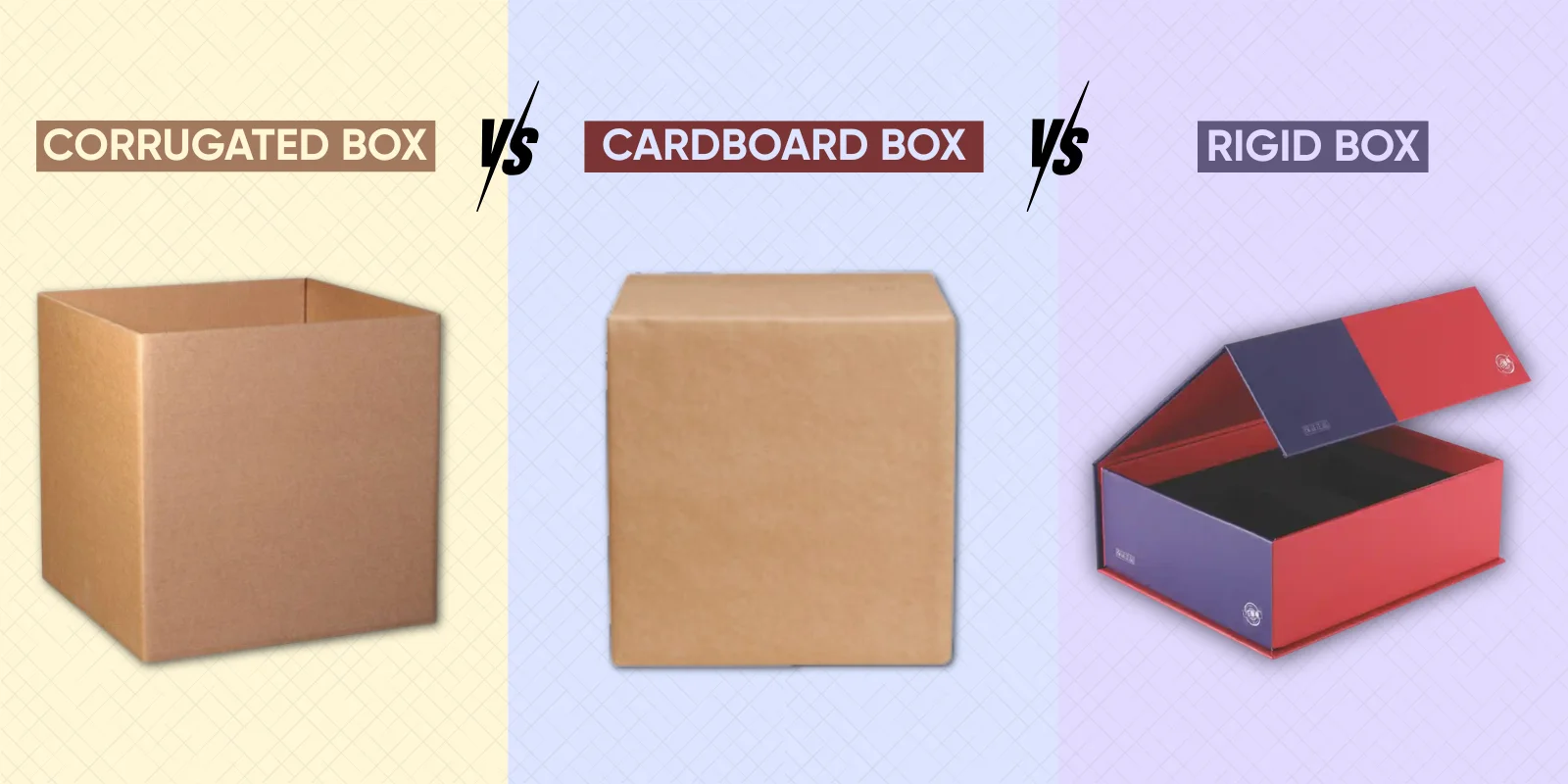
 Material #1
Cardboard is the most common choice of many businesses for its durable quality, customization, and presentation at affordable prices. If you have received a product in a folding carton, the cardboard material is used in these boxes. Cardboard offers structural support to boxes to retain their shape.
The cardboard market size was USD 124.92 billion in 2025, growing at a CAGR of 4.1% to reach USD 186.70 billion by 2032. E-commerce has increased demand by 45%.
The roots of cardboard date back to the early 1960s in China. The historical mention appears in the book Mechanick Exercises Or The Doctrine of Handy-Work — not as packaging material, but as a substrate for printing. In 1817, a German board game was sold in a paperboard box. A France Museum mentions it was invented in 1840 — and since then, cardboard has been the most affordable packaging material for most industries.
Cardboard is made from paper pulp. Various grades of recycled cardboard packaging papers are collected and layered together. Water and binding elements form sheets using specialized equipment. Multiple thin layers are laminated while damp, then pressed and dried to produce the finished cardboard material.

 Material Quality
The quality of cardboard material is evaluated by the amount of recycled fibres it contains. Based on recycled fibres, cardboard is categorized into different grades — all recyclable:
The only cardboard materials that cannot be easily recycled are wax-coated and food-contaminated types.
The win-win key strength of cardboard is its price — affordable even for small businesses and startups.
Customize cardboard to different thickness values to suit your product protection needs — while keeping costs low.
Cardboard is easily recyclable so it will not contribute to landfills. Learn more about whether cardboard is environmentally friendly.
The easiest material to customize. You can fold a cardboard box and score it into any desired shape.
Reduces shipping costs and is convenient to handle. Understanding how much a cardboard box weighs helps optimize shipping.
Can be stored and shipped flat — takes minimal warehouse space and reduces logistics costs.
From food packaging to moving supplies, office storage to DIY projects — endlessly versatile.
Cardboard is food-safe and used for confectionery, cereal, dry foods, and fast food items.
Inserts and dividers for storage and organization inside containers are made from cardboard.
Companies use cardboard cartons to move items. Explore the best ways to use moving boxes efficiently.
Organizes documents, files, stationery, and is used for crafting and educational projects.
Used as cost-saving temporary displays where permanent solutions aren't needed.
Consumers use cardboard for making hanging lamps, storage bins, doll houses, and other creative projects.
Cardboard is a versatile material that fits almost every industry — from food products to office supplies, apparel to cosmetics.
Protect food from environmental factors with recyclable cardboard packaging that can be customized to increase perceived value.
Bakeries pack treats, cakes, and sweets in cardboard packaging that keeps them fresh during delivery and takeout.
Organization and storage of items is easier — you can move stationery supplies effortlessly between locations.
Moving boxes made from cardboard are used to relocate items, then discarded conveniently once used.
Online businesses are among the biggest consumers of custom boxes, delivering products to customers daily.
Hat boxes, shirt boxes, and shoe boxes for clothing brands and the apparel industry are made from cardboard.
Sensitive electronic components are packed in sturdy cardboard packaging to prevent damage during display and storage.
Biodegradable cardboard is used as a weed barrier around plants, retaining water and improving soil quality when it decomposes.
9 out of 10 people think cardboard and corrugated fiberboard are the same material. They are not. Corrugated fiberboard is a more durable material made from paper pulp composed mainly of timber and recycled wood chips. Its secret strength? The fluted (wavy) inner sheet sandwiched between two flat linerboards.
The material has three parts:
According to the Fibre Box Association, businesses in North America ship 95% of their products in corrugated packaging.
 Manufacturing & History
In the manufacturing process, recycled paper is inserted into machines where it is heated and shaped into a wavy sheet. Workers apply adhesive to the wavy tips, and flat sheets (outer and inner liner) are pressed on both sides. Heat and pressure bond all sheets together to form the durable corrugated material — surprisingly lightweight.
The first corrugated paper was patented in England in 1856 and was initially used for hats. According to Wikipedia, corrugated material remains the global standard for shipping products worldwide today.
Understanding the outside materials helps you manufacture corrugated boxes that better meet your packaging needs:
The most sustainable option — the word "Kraft" means "strength" in German. It consists of 70–100% virgin chemical pulp fiber with about 25% recycled content. The most costly option, but produces the stiffest and most durable material.
A less expensive option with more recycled fiber content. Less durable than Kraft but commonly used as inner linerboard for corrugated boxes.
Two types are used: Semi-Chem (virgin pulp, neutral sulphite semi-chemical process) and waste-based fluting (100% recycled fibers). Specialized barrier liners offer exceptional moisture protection for food and electronics packaging.

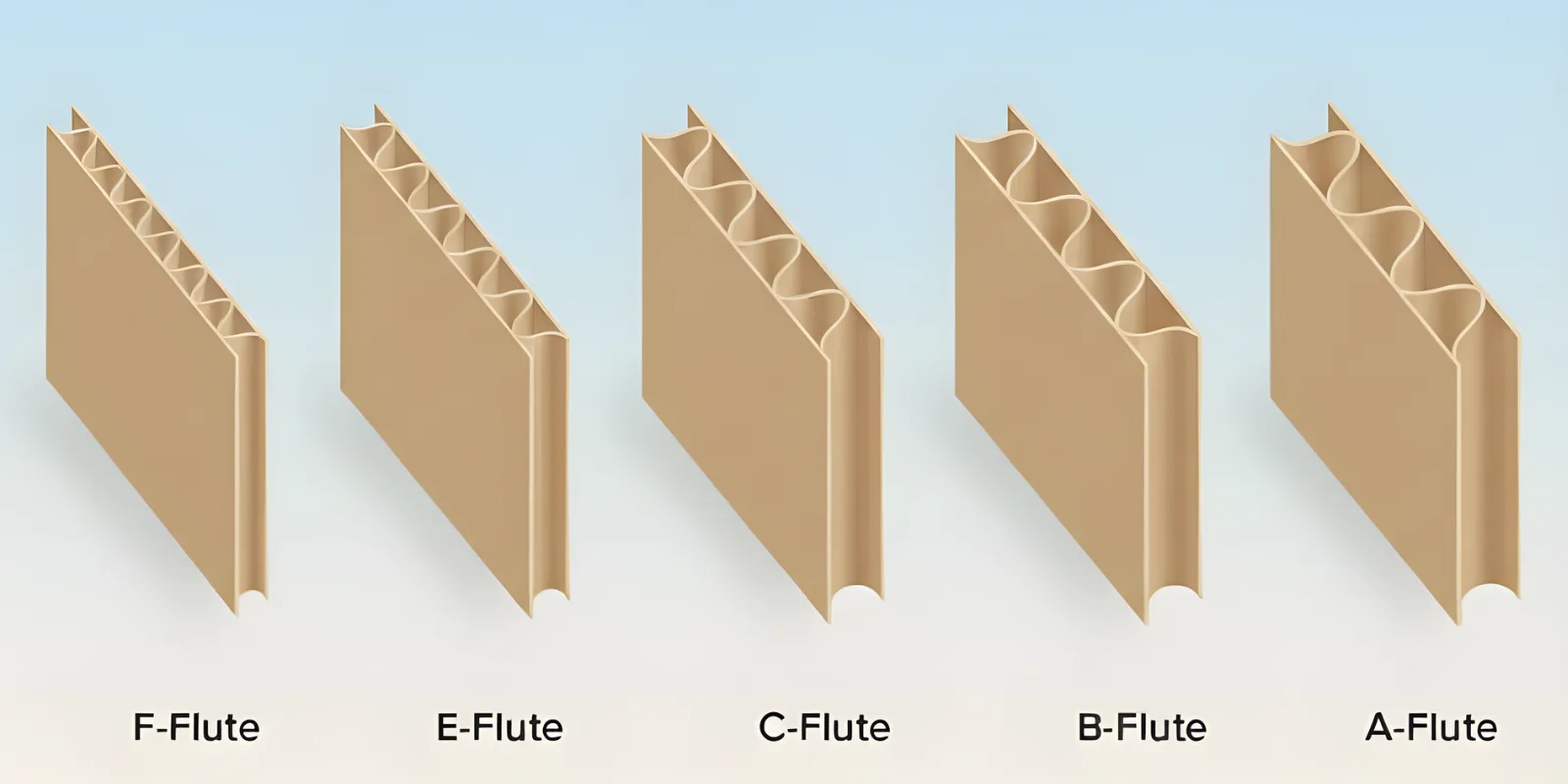
The flute grade you choose determines the cushioning, compression resistance, and strength of your corrugated boxes.

The thickest flute grade offering maximum cushioning, strength, and compression resistance. Ideal for packing fragile items and designing corrugated boxes that can withstand stacking.
Slim but strong. Provides excellent crush resistance and puncture resistance. Its flatter surface is best for higher-quality printing and easy die-cutting.
The most widely used flute grade. Flexible and versatile, offering average crush resistance and good strength for stacking. Provides a good surface for printing.
Excellent compression strength and crush resistance for fragile glass and ceramics. Also used as an alternative to paperboard folding cartons with excellent print quality.
The thinnest commonly used flute grade with a smoother surface for better print quality. Used in fast food clamshells and speciality retail packaging.
A more efficient alternative to the A and C flutes — the most durable grade designed to handle heavy items like furniture and large food boxes.
Even thinner than E flute. Offers higher flute density with an excellent printability surface. Used for luxury packaging, e-commerce, and point of sale displays.
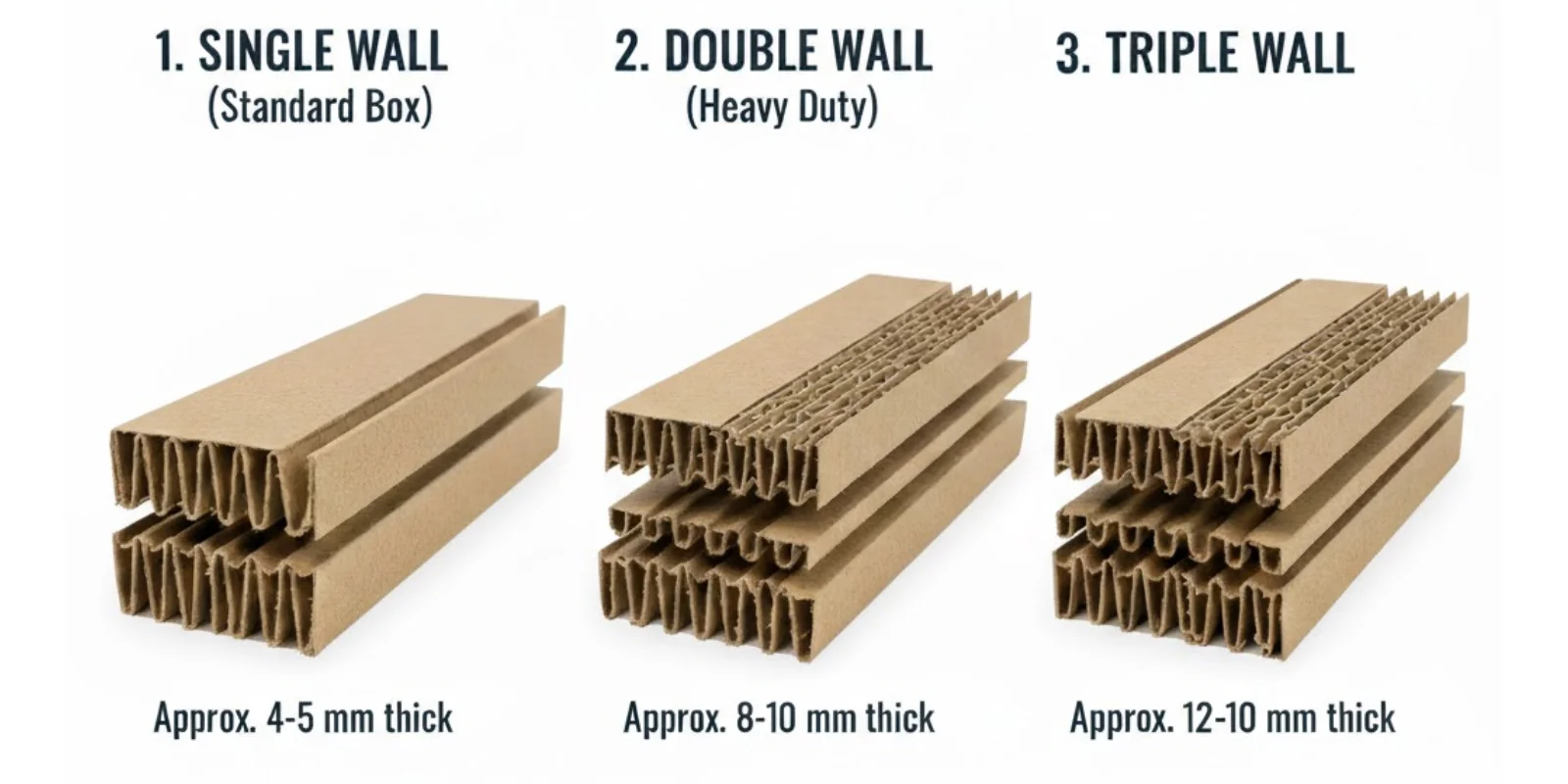
Fluting and liner materials combine in different layers to create a variety of corrugated structures:
| Wall Type | Construction | Best For |
|---|---|---|
| Linerboard | Face sheet onto which flute is glued | Base component of all corrugated |
| Single Face | One linerboard + one glued flute (visible from one side) | Wrapping and cushioning |
| Single Wall | Two linerboards + one fluted layer between them | Most common — standard shipping boxes |
| Double Wall | Three linerboards + two fluted layers | Heavier items, extra protection |
| Triple Wall | Four linerboards + three fluted fiberboards | Up to 300 lbs — industrial goods |
For handling most jobs under 20 pounds, choose single-wall corrugated boxes straightaway. For heavy products, you will need double-wall or triple-wall versions — costlier but significantly more protective.
Combines the two most protective grades (A and C). Highly recommended for harsh shipping and handling processes.
The all-rounder combination of B and C flutes — especially used for shipping boxes due to high-level protection during transit.
Combines E and B flutes for exceptional strength. The outer E flute provides a high-quality printing surface.

Best strength-to-weight ratio in packaging. A 100g box can withstand 20 pounds of product weight.
Air pockets in the fluted layer provide cushioning, keeping products safe from shocks and impacts during transit.
Shipped flat, stored flat — takes minimal space. Can be assembled in just 20 seconds.
Get custom printed boxes for under a dollar — maximum protection at minimum spend.
A, B, C, E, and F flute types — plus single, double, and triple wall options for any weight or product.
Easiest material to source from suppliers in bulk at competitive prices worldwide.
Almost every industry uses corrugated fiberboard for packaging supplies and products.
Ships every product — books, furniture, apparel, office supplies — to customer destinations.
Food-grade corrugated boxes keep food fresh while maintaining taste and flavor during delivery.
For packaging, shipping retail items, and temporary displays to grab customer attention.
Protects components and stores them during every step of the supply chain.
Ships fresh crops and fruits from farms to processing units, protecting them from external factors.
The pharmaceutical, CBD, herbal, health, and fitness industries rely on corrugated boxes.
Eight standard tests determine the quality and strength of corrugated fiberboard:
The ISTA 1A Drop Test Procedure is the internationally accepted method. The shipping carton is dropped 10 times from different sides — including the most fragile corner, its edges, and the remaining 6 sides.
A piece of corrugated material is compressed between a machine to determine how much force corners and edges can withstand before crushing. An ECT rating of 32 is acceptable for most light to medium-weight products.
A rubber ball applies pressure under the packaging to measure the force it can withstand before bursting (measured in pounds per square inch). A 200# rating means the material can withstand 200 psi before bursting.
Measures the maximum load a fully finished box can bear before failing — simulating warehouse stacking conditions. Standards: ISO 12048 and ASTM D642.
Simulates vibrations and shaking on trucks and planes to determine dangerous frequencies. Standards include ISTA 2A, ISTA 3A, and ASTM D3850-95.
A moisture meter measures moisture content in the packaging. By rule of thumb, moisture level should be less than 25% — the lower, the better.
Evaluates resistance of corrugated flutes when crushed perpendicular to the surface. Standards: TAPPI T808 and TAPPI T809.
Both are different materials — the flutes and layered construction are what differentiate corrugated from cardboard.
| Parameters | Cardboard | Corrugated Fiberboard |
|---|---|---|
| Primary Purpose | Retail product packaging and temporary displays | Shipping, storage, and transportation of fragile and heavyweight products |
| Construction | Single paperboard sheet made from paper pulp | Triple-layer material with two liners and one fluted layer |
| Thickness | 0.5mm – 2mm | 3mm – 15mm |
| Weight Capacity | 2–15 lbs | 10–80 lbs |
| Sturdiness | Less sturdy — single sheet construction | Sturdy due to layered construction |
| Product Safety | High safety when used with inserts | High safety due to cushioning effect of fluted layer |
| Reusability | Usually not reusable | Reusable |
Rigid is a sturdy material that has become the choice of businesses with a good packaging budget. If you want your packaging to scream high quality and transform an ordinary product into a luxury one, choose the rigid board. This material becomes memorable for customers and convinces them to purchase based on perceived value.
This substantial, non-bendable material is produced when multiple layers of paper fibre are bound together under intense pressure. Unlike corrugated material, it has no air pockets for cushioning. This material is 1.5 to 3 mm thick chipboard, equivalent to 300 to 600 GSM.
Workers mix paper pulp with recycled paper fibers, then add binding agents and water. This mixture passes through giant rollers under huge pressure. Moisture is removed through heat while fibers compact into dense sheets. Finally, machines use industrial-grade adhesives to laminate multiple layers — producing a non-bendable, solid rigid board.
Does not bend under external pressure or load. Retains its structure while protecting the enclosed product.
Smooth surface allows foil stamping, embossing/debossing, spot UV coating, and soft touch lamination.
Unlike cardboard, the rigid board is not sensitive to moisture — protecting products from all external factors.
When presentation matters, rigid material becomes indispensable. Mostly luxury brands with a good packaging budget use this material.
Perfumes, premium cosmetics, and luxury skincare lines. Found everywhere in luxury stores like Sephora.
Flagship smartphones, premium tablets, and luxury smartwatches. Apple uses rigid boxes for its premium iPhones.
Engagement rings, fine necklaces, and luxury watches presented in rigid boxes that command perceived value.
Designer shoes, limited edition apparel, and luxury handbags — think Louis Vuitton's iconic packaging experience.
Executive gift sets and promotional items for VIP clients deserve packaging that impresses and commands respect.
Rigid material ensures a pleasant unboxing experience for influencers. Learn more about what is a PR box.
Rigid hardcovers add worth and authority to published books, making them feel premium in the reader's hands.
Limited edition beauty products are presented in rigid boxes — because products will be judged by their cover.
Premium subscription services and limited edition enterprise-level events use rigid material for maximum impact.
Both are paperboard materials, but entirely different in terms of strength, cost, construction, and visual appeal.
| Features | Cardboard | Rigid |
|---|---|---|
| Material Composition | Binding different layers of recycled paper | Solid chipboard from FSC-certified resources |
| Structure & Assembly | Collapsible — stored and shipped flat. Not pre-assembled. | Non-collapsible — retains shape. Ready to use. |
| Primary Purpose | Temporary and retail displays, product packaging | Luxury and premium product presentation |
| Strength | Durable but not for products over 10–15 lbs | Sturdy — withstands up to 50 lbs |
| Storage Efficiency | Compact and storage-efficient due to foldable nature | Takes 3–5 times more space than cardboard |
| Cost | More affordable — also reduces shipping costs | Expensive — used by luxury brands for limited editions |
Both are sturdy materials, but different in terms of strength, visual appeal, and construction. Also compare Mylar vs rigid packaging for specific product needs.
| Features | Corrugated | Rigid |
|---|---|---|
| Material Composition | Multi-layer fiberboard (125–350 gsm per liner), 3–8 mm thick | Solid chipboard, 600–3000 gsm, 1.5–3 mm thick |
| Primary Purpose | Protection during shipping, logistics efficiency, e-commerce | Luxury brand presentation, premium retail, gift packaging |
| Strength Type | Excellent impact resistance, bursting strength, stacking | Crush resistance, shape retention, edge protection |
| Print Quality | Good to excellent — flexo, litho-lamination, digital | Excellent — offset, PMS, foil stamping, embossing, UV |
| Storage Efficiency | Space-efficient — ships flat for bulk shipment | Requires 3–10 times more space than corrugated |
| Sustainability | 70–100% post-consumer content, 67–84% recovery rate | Reusable 10+ years — FSC-certified |
| Cost Range | $0.30–$3 per unit | $2–$20+ per unit |
| Customer Perception | Functional, protective, and professional | Luxury, premium, gift-worthy |
When it comes to shipping and storage, corrugated fiberboard is the most preferred option. Cardboard is durable but not suitable for transporting fragile products. Rigid material takes 3× to 10× more space. Corrugated can be folded, takes up less space, and is heavy-duty enough to withstand stacking.
All materials meet certain printing needs, but differ in surface quality. For basic text and logos, any material works. For detailed graphics, avoid cardboard. The rigid board performs best for photo-quality printing.
| Product Weight | Recommended Material |
|---|---|
| Under 15 lbs | Cardboard, Corrugated, or Rigid — all suitable |
| 15–25 lbs | Corrugated or Rigid — avoid cardboard |
| 25–50 lbs | Heavy-duty corrugated or Rigid |
| Over 50 lbs | Corrugated fiberboard only |
Rigid materials are more expensive than cardboard and corrugated — for good reason. They are thicker, don't require manual assembly, and are ready to use. Cardboard and corrugated are more affordable, foldable, and reduce shipping costs — designed for mass production.
All three materials are sustainable but benefit the environment in different ways. We recommend sourcing from FSC-certified resources.
| Factor | Cardboard | Corrugated | Rigid |
|---|---|---|---|
| Recyclability | Highly recyclable with high acceptance rates | Excellent — 88.8% acceptance rate in the US | Moderate — easier when non-paper elements are removed |
| Reusability | Usually discarded after one use | Limited — main purpose is shipping | Highly reusable for 10+ years |
| Recycling Challenges | None for standard cardboard | Minimal — corrugated fibers are easy to recycle | Magnetic closures, ribbons, foam inserts are harder to recycle |
Follow this decision framework to choose the right material without guesswork:
Retail Display & Packaging: If branding is the goal at lower cost, go for standard cardboard. If budget is not an issue, choose rigid board.
Logistic Efficiency: Corrugated fiberboard is recommended — lightweight and space-efficient, reducing shipment costs.
Brand Experience: Rigid box is the preferred choice, followed by standard cardboard, then corrugated.
Retail Price: Under $25 → corrugated or cardboard (1–2% budget). $25–$50 → cardboard (2–4%). Over $50 → rigid material (3–10%).
Fragile Assessment: For glassware, jars, and sensitive items — heavy-duty corrugated or rigid with inserts. For non-fragile products — cardboard.
Weight: Under 15 lbs → any material. 15–80 lbs → corrugated. 15–25 lbs → rigid also suitable.
E-commerce: Corrugated or cardboard for presentation and protection during transit.
Retail Shelf Display: Cardboard for die-cut windows; rigid for enhanced presentation.
Omni-Channel: Hybrid approach — Cardboard or Rigid Inner + Corrugated Outer.
Mass Market Products: Budget target 1–3% of retail price → standard cardboard or corrugated.
Mid-Tier Consumer Products: Budget target 3–7% → printed cardboard.
Premium & Luxury Products: Budget target 5–15% → rigid material.
Low Volume (<1,000 units/month): All materials viable. Rigid feasible if in stock.
Medium Volume (1,000–10,000 units/month): Cardboard most affordable; rigid for premium branding only.
High Volume (>10,000 units/month): Rigid only for limited edition/luxury. Cardboard and corrugated most feasible.
If you are new to packaging decisions, you might make these common mistakes. Learn them so you can avoid them:
Rigid boxes lack a cushioning effect. If heavy items are packed in these boxes, they can rupture the corners during transit. Rigid is not designed for impact resistance — corrugated is.
It is a myth. With high-quality corrugated material and proper customization, they outperform more expensive materials. Customers appreciate sustainable, eco-friendly choices.
Focusing solely on aesthetics or initial material cost creates additional hidden costs. Packaging is not merely a container — it is a driver of the supply chain.
Over-packaging increases operational costs, frustrates customers, and negatively impacts the environment. Match your packaging to your product's actual needs.
The final comprehensive comparison that makes your concept crystal clear:
| Features | Cardboard | Corrugated | Rigid |
|---|---|---|---|
| Material Composition | Single-layer, multiple grades of recycled paper | Triple-layer — fluted layer between linerboards | Dense, non-collapsible — multiple layers under intense pressure |
| Thickness | 0.5mm – 2mm | 3mm – 15mm | 1.5mm – 6mm |
| Primary Purpose | Lightweight item packaging and display | Shipping and transportation of fragile and heavyweight products | Enhanced presentation and luxury appeal |
| Weight Capacity | 2–15 lbs | 15–80 lbs | 25–50 lbs |
| Strength | Low — single-layer construction | Excellent — triple-layer + fluted cushioning | Excellent — thick, dense, non-bendable |
| Recyclability | Highly recyclable | Excellent — 70–100% post-consumer content | Moderate — special processing required |
| Cost | Most affordable | Slightly more than cardboard | Most expensive |
| Printing Quality | Fair — best for basic text and logos | Good to excellent — flexo, litho, digital | Best — photo-quality, foil stamping, embossing |
| Density (GSM) | 200–350 | 125–440 | 400–1200 |
| When NOT To Use | Heavy products; intricate printing; moisture-prone environments | Luxury retail displays; where detailed aesthetics are critical | High-volume shipping; tight budgets; space-constrained storage |
Go for cardboard if you want to protect your products while increasing their visibility on retail shelves at an affordable price.
Go for corrugated for excellent impact resistance for fragile and heavyweight products. Storage, shipment, and handling are easier with lower shipping costs.
Go for rigid when the goal shifts to visual luxury appeal that creates social media moments and helps you get the value from customers that your product deserves.
At My Box Printing, we have spent years helping businesses make such decisions. We source materials from FSC-certified resources. Order your custom boxes in any of these materials that best suits your packaging needs.
Rigid boxes are stronger than corrugated boxes as long as they are not dropped or have to withstand impacts. Corrugated boxes are more durable because of the fluting materials that offer cushion resistance and shock absorbance to protect products from damage.
Corrugated material is the best for e-commerce shipping because of its exceptional strength, impact resistance, and cushioning effect. The corrugated boxes are compact and safe to stack on top of each other, also reducing shipping costs significantly.
Rigid material is best for luxury gifting because the packaging itself matches the vibe of the gift. It makes the gift more valuable by improving its presentation and creates an unforgettable moment for the gift recipient.
Yes. Corrugated boxes are highly recyclable because of the 70–80% recyclable fibre content. If the rigid material is made from FSC-certified chipboard, it will be eco-friendly as well.
The rigid boxes are 3 to 10 times more expensive per unit than corrugated boxes due to premium materials. Shipping costs are also higher because of the non-collapsible structure.
Corrugated material has a slight advantage because it contains 70–100% recyclable post-consumer content with a recovery rate of 67–84%. However, rigid material is reusable for up to 10+ years. A hybrid approach — corrugated outside, rigid inside — would be the most eco-conscious solution.
Yes. Modern printing techniques like litho lamination, digital, and flexography printing work well with corrugated boxes to enhance their visual appeal significantly.
Chipboard is a denser material (600–3000 gsm) making it non-bendable with a smoother printing surface. Corrugated is made from a fluting layer surrounded by liner materials, 3–8 mm thick — highly recommended for shipping heavy to fragile items.
The best material for PR packaging is rigid board. It looks luxurious, gives the receiver social media moments to share, and promotes your brand without additional budget.
Mostly corrugated cardboard is used for subscription boxes because of affordable price and ease of customization. For limited edition products and enterprise-level events, rigid material is used.
Apparel businesses use all eco-friendly materials depending on goals and budgets. Brands usually use Kraft paper and corrugated for clothing items. Luxury brands use rigid materials that match their standard.
Cardboard and corrugated are budget-friendly options for holidays and special events. For a premium seasonal appeal, rigid material is the ideal choice.
Every gift deserves special treatment. Rigid boxes enhance the presentation of gifts, make the recipient feel more valued, and create a memorable moment. The rigid box looks luxurious and convinces the customer to pay the demanded price.
Get expert advice and custom packaging tailored to your product, brand, and budget — sourced from FSC-certified materials.
Get a Quote