
Have you ever considered how many cigarettes are in a pack when you purchase one? The answer reveals a lot about the complexities of cigarette packaging and the global tobacco market. The transition from the standard pack of cigarettes to the sizes that come in different regions shows a well-knit web of regulations, marketing strategies, and what consumers prefer.
This article will explore the various styles of cigarette packs, such as soft packs, hard packs, and flip-top packs. It will examine their influence on cigarette pack dimensions and how they affect the experience for consumers who purchase them. Our investigation will further include the carton dimensions and the pack sizes of cigarette cartons ranging from 10 packs to 200 cigarettes. We will examine why there are places where packages with 25 to 30 cigarettes are preferred over the usual 20 cigarettes per pack.
Moreover, at the end of this conversation, you will have a thorough understanding of the cigarette carton sizes, how pack size influences cigarette consumption, and why the quantity of cigarettes that come in each pack matters.
Historical Context: Evolution of the Cigarette Pack
Early Packaging & Flip-Top Pack
Earlier, cigarettes were sold in big quantities, wrapped in plain paper or foil. They had no distinctive marks or a standard appearance. In 1915, the flip-top pack created a huge sensation in cigarette packaging. It provided a secure place to store cigarettes and simultaneously provided companies with an ideal place to display their logos and messages.
Growth in Pack Variety & Designs
With the turning pages of the calendar year after year, the variety of cigarette pack designs broadened ever more extensively. Various categories of cigarette packs, hard packs and soft packs, began to spring up all around, highlighting the multifaceted tastes of the smokers. In the cigarette packaging world, the innovation trend continues to advance with the launch of new slide packs and lid packs that are specifically made to keep pace with the evolving consumers' needs.
Standardization of the 20-Cigarette Pack
In the modern tobacco world, one pack containing 20 cigarettes has become standard. This forms the benchmark for the cigarette pack size across the entire world, being the most prevalent measurement for carton dimensions.
Why are 20 cigarettes in a pack? Logic Behind It
The choice of 20 cigs in each pack or 10 cigarettes per pack is no more casual; it's just an easy number to carry.
-
It's a standard number of cigarettes that is convenient to carry.
-
It makes it easy to decide the price of cigarettes.
-
It corresponds with tax brackets and legal regulations in many packs of cigarettes sold around the world.
Moreover, packs with 20 cigarettes are manageable for daily usage, as it implies that the smoker does not carry a maximum number of cigarettes at once.
Standard Pack of Cigarettes Around the World

The pack of cigarettes contains 20 cigarettes, which are most commonly seen standing up on store shelves in the United States. The cigarette pack size changes when observed on the global market.
Australia
Relatively larger packs of cigarettes that can hold 25 to 30 cigarettes are commonly found.
Canada
You can buy cigarettes in bulk, where a standard pack contains 20 cigarettes individually.
Asian countries
Majorly, a cigarette pack usually contains 10 or 25 cigarettes, with the pack being suitable to the region's culture and legislation.
While 20 cigarettes per pack are universal, the number of cigarettes in a pack varies around the globe according to culture and policy.
Standard Cigarette Pack Dimensions of Popular Brands
When one looks at the sizes of cigarette packets, it can be seen that brands make themselves unique with differences in their packets. Here's another example:
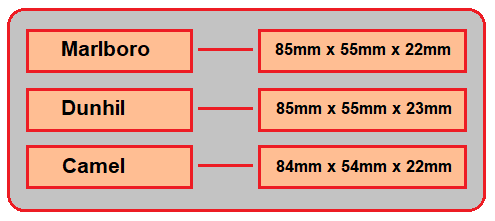
Marlboro (85mm x 55mm x 22mm)
Dunhill (85mm x 55mm x 23mm)
Camel (84mm x 54mm x 22mm)
The sizes listed above are the ones you will most often find in many of the top cigarette brands available. If there is any confusion over the size of the pack in question, a quick glance at the dimensions listed on the cardboard cigarette box itself can help clarify how different brands follow or deviate from the typical sizes. Even though it may look like a small feature, it tends to be highly beneficial when comparing packaging on a larger scale.
Even though it may look like a small feature, it tends to be highly beneficial when comparing packaging on a larger scale.
Regular Size Box
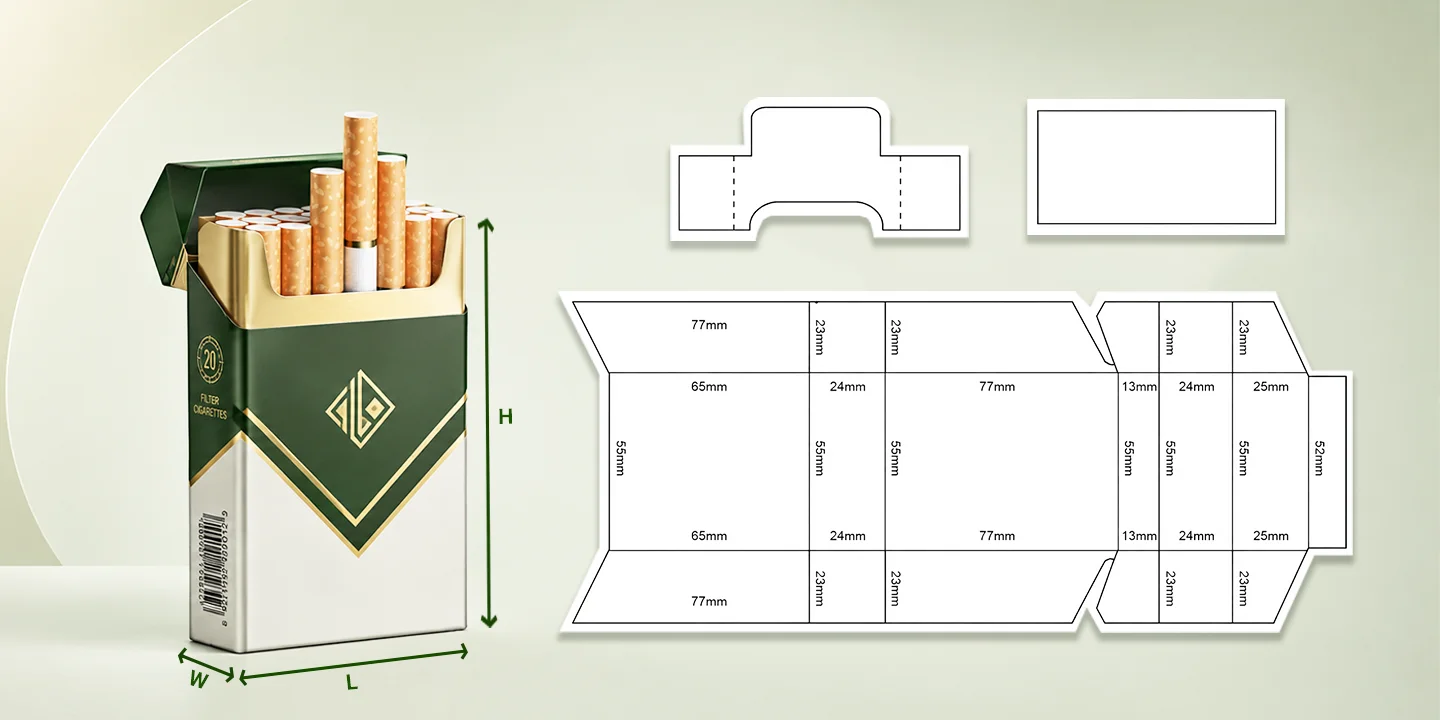
84mm (3.3 inches) in height, 55mm (2.1 inches) in width, and 22mm (0.87 inches) in depth. This is for a regular-size box.
King Size or Compact Size
King-size boxes are longer, around 100mm (3.9 inches) in height, 60mm (2.4 inches) in width, and 25mm (1 inch) in depth. Compact sizes are also common, about 85mm x 56mm x 22mm.
These are the standard number of cigarettes in a pack and also the length of a cigarette that is inside the box. According to the geographical locations, these can vary.
Cigarette Length & Size
Cigarettes have different sizes and lengths, which normally vary with the brand or where they are sold. Let's get into a basic overview of the most commonly observed types:
Standard Size
The typical length of a standard cigarette will range between 70 mm and 85 mm, which is roughly 2.75 to 3.35 inches when measured.
King Size
In the cigarette universe, King Size is unique in being slightly longer than the norm, ranging from 84mm to 90mm, or about 3.3 to 3.5 inches.
Long Size
For those who like to linger over a longer smoke, the long-size varieties are available. They come in 100mm to 120mm. That's roughly 3.9 to 4.7 inches for anyone who's measuring.
Slim Size
Slim-size cigarettes are distinguished by their slim and slinky appearance. They tend to be the same length as the extended ones, between 100mm and 120mm. But their diameter is smaller. Several choices are offered to accommodate smokers' varied preferences so that they can have the choice of selecting the one that suits their style and experience.
Uncommon Cigarette Pack Sizes
10-Cigarette Packs
Although the "standard pack contains 20 cigarettes", 10-cigarette packs are still found in some places. Some markets provide these smaller packs for those who smoke less often, or they're distributed as part of a sales campaign. More often than not, they are considered a cheaper alternative for those who are not yet willing to spend money on a whole pack.
In regions where larger packs of cigarettes are mostly preferred, smaller packs are a means of cutting down the cost of cigarettes per pack and offering alternatives in packaging and selling.
25-Cigarette Packs
In regions like Australia, seeing packs of 25 cigarettes for sale is quite normal. These large packs are designed for frequent smokers who prefer purchasing more cigarettes in a pack. The cigarette carton has multiple packs, and each pack has 20, 25, or more cigarettes. Knowing the exact number of packs in a standard cigarette carton makes it easier to compare pricing and estimate consumption.
Individuals who like purchasing items by the dozen or bargain hunters will find these packs to be a great option. Most people find it convenient to purchase cigarettes in bulk, particularly in areas where being able to obtain a good deal and having plenty of them is very important.
These pack sizes highlight how different types of cigarette packs cater to diverse smoking habits and price preferences globally.
Cigarette Cartons and Bulk Packaging
When thinking about how many cigarettes one can buy in bulk, one must think about the carton. A carton of cigarettes contains 10 packs in every carton, and normally, every pack contains 20 cigarettes, typically, which makes up 200 cigarettes in total.
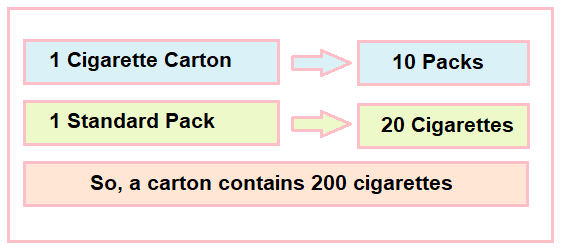
Let's simplify it:
1 cigarette carton = 10 packs
1 standard pack = 20 cigarettes
So, a carton contains 200 cigarettes.
Most individuals buy products in bulk; others do it to reduce the number of visits to the store, while others seek to save on costs. In cases of bulk purchase, the capacity of the boxes and the pack sizes come into play as far as planning logistics is concerned.
Types of Cigarette Packs in a Carton
Within the vast universe of tobacco, the cigarette packaging types can differ significantly. This is to satisfy the various preferences and requirements of consumers. Considering the spectrum from robust packs for everyday use to silky and special ones individuals may retain, let's look at the common cigarette pack types included in the world:
Soft Cigarette Pack
Constructed from either kraft paper material or cardboard material, it is easy to carry around, but it lacks when it comes to protecting the contents from damage. To demonstrate their emphasis on careful detail and centuries-old craftsmanship, many high-end and artisan cigarette brands opt to use soft packs. A pack typically includes about 20 cigarettes. It is ideal for smokers who value being able to take their equipment on the move and have a classic, flexible experience.
Hard Cigarette Pack
Manufacturers craft a tough cigarette pack from robust cardboard or plastic, ensuring it feels firm to the touch and guards against being squashed effectively. This type enjoys widespread popularity for its useful characteristics and ability to endure over time. In a pack, one will usually find around 20 cigarettes. Ideal for those who need a reliable case that provides protection and will endure day-to-day wear and tear.
Flip-Top Pack
A flip-top pack, commonly referred to as a hinged-lid pack, features a lid that opens and closes tightly. It keeps the cigarettes fresh and prevents them from falling out. Most smokers love this kind since it's convenient to use and closes securely. This applies to individuals who prefer luxurious as well as standard brands. It usually contains 20 cigarettes per pack. Ideal for smokers looking for a pack that is convenient to use and maintains their cigarettes fresh and in good condition.
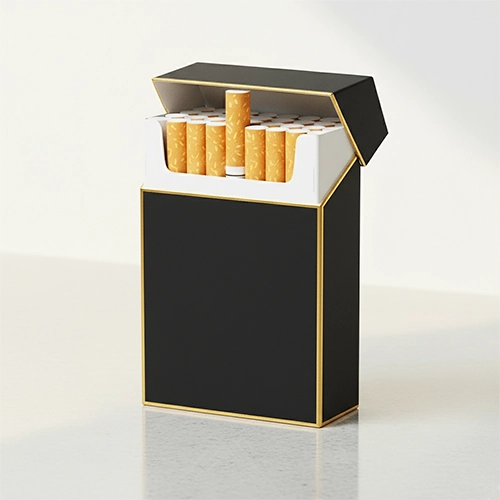
Slide Pack (Cigarette Box Pack)
A pack that is called a slide pack or sometimes a cigarette box pack has an opening like a drawer that slides out to reveal the cigarettes within. Premium cigarette brands often choose this kind of box packaging because it gives their product a sleek and sophisticated appearance.
The smoking experience receives a touch of class from its fashionable appearance. In a pack, there are typically 20 cigarettes or more. Great for those who enjoy contemporary style and desire a more upscale means of accessing their cigarettes.
Single Die-Cut
These custom boxes are made with a single corrugated cardboard piece with the sides tucked in. easy to make and also eco-friendly.
Plain Packaging
In this type of packaging, the standardized shape and color are used. Customization in every section doesn't work here, as there is already a standard size available.
Slim Boxes
In these types of boxes, the diameter is less than normal. For example, the pack of 10 cigs. The consumers who are less into smoking and smoke occasionally.
Shoulder Boxes
These are less seen, but in shape, they have a wider base than the top.
Luxury Rigid Boxes
These are for the premium clients out there who want to add a touch of luxury and importance to their product and to make the person feel premium. Premium-designed boxes are for high customer satisfaction, who always prefer more quality in the packaging too, and that makes these boxes stand out.
The premium ones are also defined as the personalized boxes that are made under the demand of your brand.


Moreover, let me share with you the packaging materials that are used for the packaging of cigarettes, as packaging material is the main ingredient of the recipe.
Regulation of Cigarette Pack Size
In many countries around the world, the regulation of the cigarette pack size is gaining much attention. When examining this subject, it's important to keep in mind several key points.
Regulating Pack Sizes to Counter Price Manipulation
Firstly, it's quite clear that price is closely related to the quantity of cigarettes contained in a pack. In an attempt to manipulate prices while keeping customers addicted, cigarette companies often change the pack sizes regularly.
By opting for small or irregular packets, companies create an impression of affordability, particularly following an increase in taxation, which prevents the consumer from detecting increases in prices in general. That is why direct regulation of cigarette packet size can be used to regulate their perceived affordability and accessibility.
Regulating Pack Sizes to Reduce Smoking Rates
One of the considerations for proposing regulation on what cigarette pack sizes should be is that it may prevent additional people from smoking and perhaps even get certain people to give up. There is a lack of proper evidence that lowering pack sizes on cigarette packs does not get individuals to stop smoking. Therefore, one could argue that adopting this kind of policy might not prove to be worth the spent money.
Packaging Restrictions as a Tool to Limit Cigarette Appeal
One last analysis reveals that the effort to manage the size of cigarette packs would often be joined by limitations imposed on their labeling and design details. Since around 2011, several governments have introduced stronger packaging rules seeking to reduce the marketing value of cigarette packs. Typically, these efforts seek to detract from their appeal by enforcing regulations on the usage of logos, color, and graphic details.
Legal And Ethical Implications For Cigarette Packaging
Labeling In A Pack Of Cigarettes
Labeling a product package is very crucial. It should also follow the rules and regulations of the country where you are living, not only this but also this is the moral responsibility of the company to show the ingredients of impacts via printing on their packaging.
The rules in different areas but let's discuss in detail the rules to follow within the United States of America.
Health Warnings
Health warnings should be written clearly on the packages and the warning must be printed on the top 50% and rear panels of the box. It should be very clearly mentioned.
Graphic Warnings
FDA mandates the use of graphic warnings that clearly explain how negatively consuming the product can be, also this should be accompanied by textual warnings.
Placement And Size
Warnings should be in 17-point type. Or as far as a minimum of 60 % is covered.
Contrast
The warning should be in black on a white background.
Brand Logo
Cigarette packs can have a brand logo but it should not overshadow the warning caution on the pack.
No Of Cigarettes
It should be mentioned on the pack how many cigs the pack contains.
Misleading The Consumer
It is unethical to mislead the consumer by putting the warnings in lighter graphics or not much clearer images of warnings.
The above-mentioned labeling rules are only for the United States of America. For other countries, these can vary according to the region.
Economic and Marketing Considerations
Pricing Strategies
To attract a variety of customers, cigarette companies tend to alter features of their products, such as the pack size and price. For instance, cost-conscious smokers like less expensive products; however, others like premium brands that give off an air of luxury. The brands can capitalize on the opportunity to align their products better with what their market loves and can afford by either changing the dimensions of a cigarette pack or altering the quantities of cigarettes per pack.
Branding and Packaging
How a brand presents itself to individuals is highly affected by the design and feel of its cigarette packages. Within an industry that has so many competitors, standing out is essential. Brands invest serious cash into bold and creative designs as well as unique packages. They do this just as much for attention as for solidifying their brand's reputation and building customer loyalty.
Factors Affecting The Cost
There are many factors that affect the cost of a finished product. Such as;
Size Of The Pack
The size of the pack is the main factor that affects the cost of the product and is directly proportional to the quantity of a product is very important in this field too.
Material Cost
The material cost can be different with the passage of time. This is not fixed as the market value fluctuates and the raw material can have different prices with time, which is why a finished product will be affected by the current price of the material.
Foil Cost
The foil that is used inside the cigarette pack also affects the pack price, mostly for the premium brands the cost is higher.
Printing And Design Cost
The printing and design cost varies with the design you want and the printing, there are several types of printing available that also impact the pack price.
Cultural and Market Influences on Cigarette Packaging
A smoker looks at a pack, not just for its content but for what it represents. In many cigarette markets, either flashy colors or minimalistic branding is used based on regional aesthetics. Cigarettes come in different styles of packaging according to cultural tastes and pricing tiers. When customers wonder how many cigarettes they’re buying, the brands rely on visual recognition.
The Impact of Cigarette Pack Size on Smoking Habits
Research by the National Library of Medicine of America indicates that the price of cigarettes and pack size have an impact on how much people smoke. Typically, a pack holds 20 cigarettes, but if the cigarette pack holds a higher number, say 25 or 30, it can lead to increased consumption of cigarettes.
Some regulators are concerned that packs containing 10 cigarettes or fewer can lead to making cigarettes more accessible. Therefore, packs of 20 cigarettes or less than 20 cigarettes altogether are commonly prohibited.
Taxes on Cigarettes
Various states handle their taxes differently; some apply a tax rate per unit, while others tax according to a percentage of the wholesale price. For New York State as well as New York City, a pack of 20 cigarettes with an excise tax added up to $4.35. In New Jersey, for each pack of cigarettes, a tax of $1.25 is charged.
Also, when purchasing cartons of cigarettes in this state, one must possess tax stamps that have been authorized by state and local government authorities. It's left to the wholesale dealers and the producers of the products to ensure the payment of the tax, and they must submit a return every month, whether they have any tax to pay or not.
Future Trends in Cigarette Packaging
Sustainable Packaging
With time, eco-friendly materials are in high demand. In terms of cigarette packaging, it is seen that the warnings are clearer and emphasized with graphics.
Customizable Pack Sizes
The trend can shift to personalization, where individuals get to decide on pack sizes that fit what they like and how much they smoke.
Smart Packaging Features
Through the use of QR codes or electronic tags, there is a big gateway opened for product information, health warning messages, or even special promotions, all of which can enrich the way consumers engage with products
Minimalist and Regulatory-Compliant Design
When the world desires to enhance public health, the flow of plain packs with bigger health warnings and fewer brand images is bound to travel far and wide.
Larger Health Warnings
As we are moving forward, the printing of warnings on cigarette packs is getting larger, and most of the packaging goes to the warning section to warn people about the health issues.
Smaller Pack Sizes
Some trends are suggesting less number of cigarettes in a box or pack, which may help people control smoking.
Premium and Limited Edition Packs
Even though under tighter control, brands will still bring out special or culture-related editions as one-off issues to retain their mystique and appeal to specific market niches.
Frequently Asked Questions About Cigarette Quantity In A Pack
How many cigarettes are in a standard pack?
A standard cigarette pack usually contains 20 cigarettes. This is the most popular pack size worldwide, with a few countries selling 10, 25, or 30 cigarette packs.
What is a 10-pack of cigarettes referred to as?
Sometimes named a "half pack," a 10-pack of cigarettes gets its nickname for containing half of what one would normally find in the standard 20-pack.
Are there 30 cigarettes in a pack?
In fact, in countries like Australia, there are cigarette packs containing 30 cigarettes. They are meant for buyers who prefer to purchase heaps at a time because they give a lower price per cigarette.
How many cigarettes a day is considered heavy smoking?
Usually, one will be regarded as a heavy smoker if one lights 20 cigarettes or more in a day. However, even when smaller numbers of cigarettes are used, the health hazards are still pretty serious.
Can cigarette packs become stale or lose their freshness with time?
Even though there is no specific expiration date for them, exposure to factors such as air moisture or heat can reduce their flavor and overall quality. This especially applies to cigarettes in soft packs or poorly sealed ones.
Can I customize the number of cigarettes in a box?
Yes, you can! If you want 22 or 36 or can go up to 30, you can do it. As per the consumer’s demand, the number can vary.
What will be the price? If I want to customize the design. Do you charge extra?
For quotations, you can always reach out to us and ask for your price, telling us in detail about what kind of customization you want and what kind of material you would want to use in your boxes.
Do you offer design services as well?
Yes, we do offer design services as well. If you have a rough design or sketch you can send us, we can give you an idea of a mockup design of the pack how the cigarette box will look after making.
Do you offer eco-friendly packaging?
Yes, do not worry about the quality, it will be eco-friendly and can be designed according to your demand.
How much time is needed for an order to be completed?
It depends on the quantity of the order, also if you are going to take the standard design that we already have or if you want to customize it further.
Do you offer mockup designs?
Yes, we do offer mock-up designs. Once you approve, we move forward after your satisfaction.
Do you offer rush printing/packaging services?
Yes, we are available for you. For a quote, leave us a message with your contact details, and we'll get back to you ASAP.
Do you offer all types of printing?
Yes, we offer embossed, UV, digital, and many other types of printing.
What kind of finish do you offer?
We offer glossy and matt both kinds of finishing.
Conclusion
Knowing how cigarettes come in one pack, the average number of cigarettes in a standard unit, and the overall number of cigarettes in a carton provides important information for purchasers, those who control, and those who market. Ranging from a few cigarettes in a standard pack to the bulk order of 200 cigarettes in a carton, each type of packaging yields information about the strategies of the industry, the habits of the consumers, and the issues regarding public health.
For companies looking for cigarettes to be packed economically and within legal limits or who are curious about how many packs in a carton to accommodate their inventory needs, MyBoxPrinting is here to help. Contact us today at 847-200-0974 to learn more about our customized pack and carton solutions that meet regulatory needs and the demands of the marketplace.