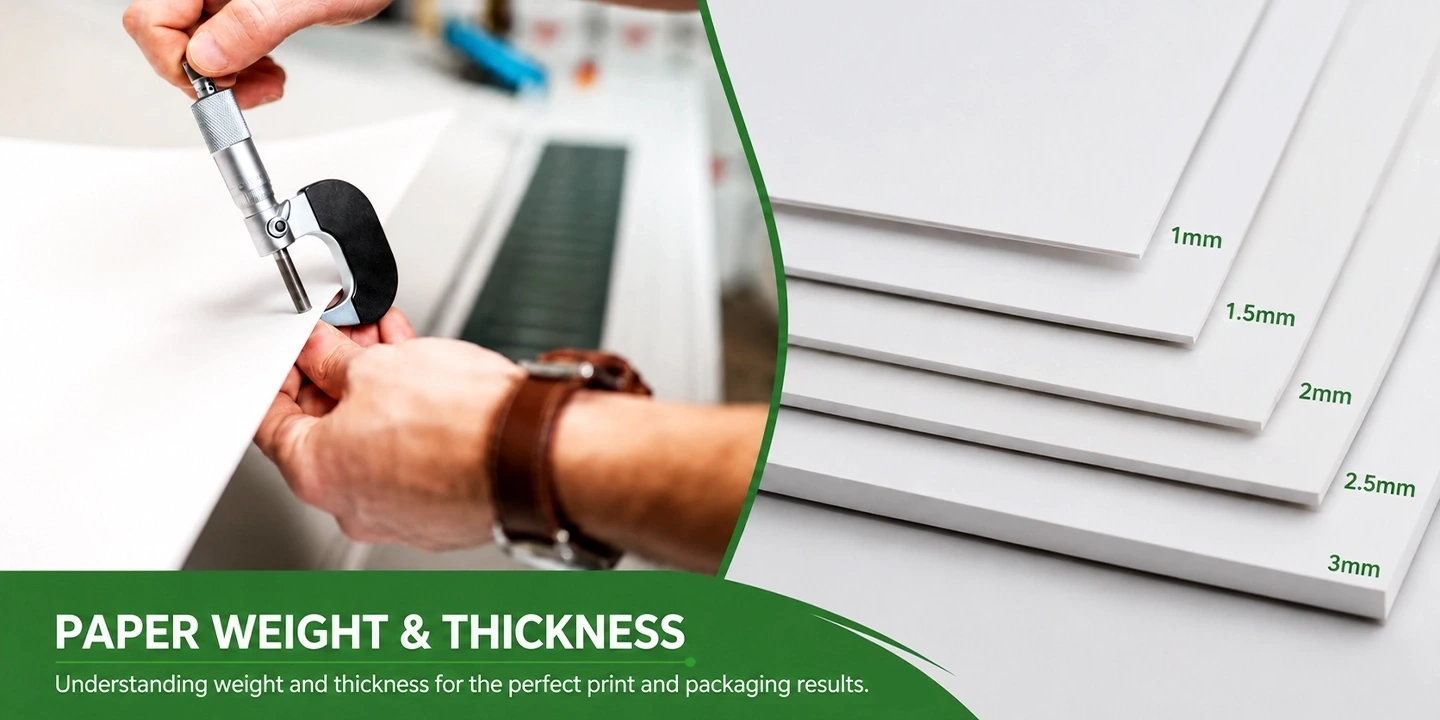
Paper weight, whether it is in GSM or LBS, can get confusing, especially with its thickness. Do you know how they are used and are different from one another? These two terms determine the feel, fold, and behavior of the paper in packaging and other applications.
With these two terms, the durability, how see-through the sheet is, and how much printing pressure it can handle depend on it. Any brand that wants to buy such sheets should understand how a little change in the GSM can affect their packaging. So read through this blog and find out.
The Difference Between Paper Weight and Thickness
A common thing about these two is that they measure the same thing: paper density. That’s it! Both of them are very different from one another in multiple aspects:
-
Paper Weight: It is measured by a scale. That’s actually the thickness and how heavy the sheet is. The paper weight is measured in pounds (lb) or GSM. If the GSM of the paper is heavier, it means it is more sturdy. Think of tissue paper and cardboard; they both have different weights.
-
Paper Thickness: You measure thickness (vernier caliper or screw gauge) with a ruler in microns or mils. It helps you determine how much you can fold, bind, and stack the paper, which is important for brochures, business cards, and even packaging.
What Is the Importance of Paper Thickness and Weight?
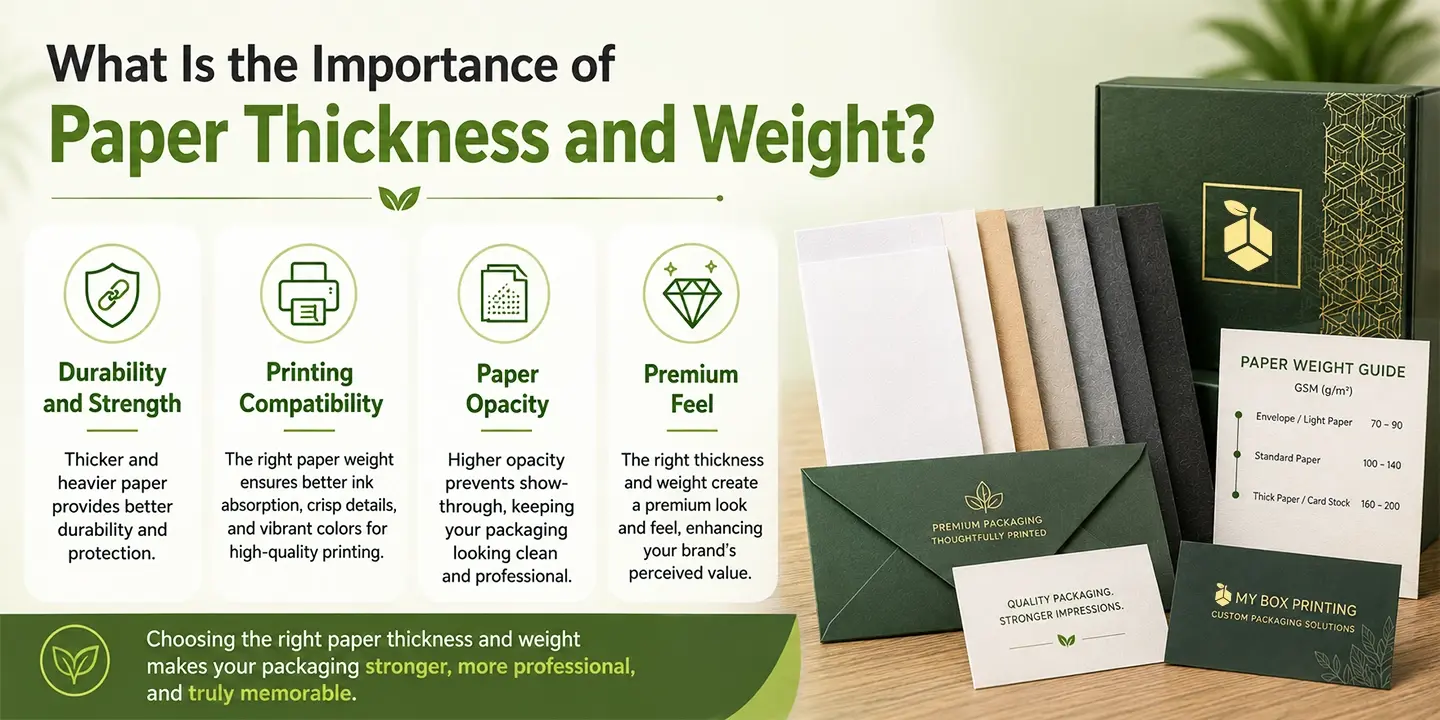
If you want to improve the print quality and durability of the paper, its weight and thickness are important to understand. This will ensure that you can create a functional and aesthetic product.
-
Durability and Strength: The thickness tells the customer how heavy the paper is and how much it can resist bends, tears, and creases. This will make for great business cards, postcards, and more.
-
Printing Compatibility: Paper weight is influenced during the printing process, such as how much it prevents ink bleed, smudging, and printer jams.
-
Paper Opacity: If light passes through your paper, it affects print visibility and lets the text be seen through the paper.
-
Premium Feel: Brands can get a luxurious-looking feel with a heavier stock, and it even helps display quality and value to your packaging, invitation, and marketing material.
How Paper Thickness and Weight Are Measured?
The measurement system is different for both paper weight and its thickness. This is why various packaging or printing companies mention them both on their product boxes.
Paper Weight Measurements
It is measured in two ways:
-
Pounds (lb): A ream, which is about 500 sheets, is weighed at an industrial paper standard size, which is not the same across every type of paper category. Papers like bonds, texts, or covers are all measured in different base sheet sizes. So, you'd better check the paper type with the number to get the right-weight paper.
-
GSM: Industries weigh a single sheet (1x1 meter) instead of measuring the whole ream. As the number is used directly, it is a much clearer and more easily compared number.
Paper Thickness Measurement
The thickness is measured in the following:
-
Points (pt): If you want to measure heavier and more sturdy paper stocks, measure them with this, as one point equals 1/1000th of an inch. That basically means a paperboard (18 pt) is 0.018 inches thicker. It comes in handy for your business cards, rigid packaging, or folding cartons. Caliper, mils, or microns: they are all written in the same way.
Why Does LBS (Pounds) Matter?
It is a traditional paper weight measurement that says that 500 sheets is equal to one ream of paper. There is a different base sheet size for each paper grade; the same pound can display it as different thickness. For example, 20 lb bond paper is approx. 75 GSM, 24 lb is 90 GSM, etc. The LBS system is used widely, but in North America, GSM is the international standard.
What Are the Types of Paper Stocks Available?
They are made for different applications such as books, brochures, business cards, or packaging. Their weight and thickness determine how they will print.
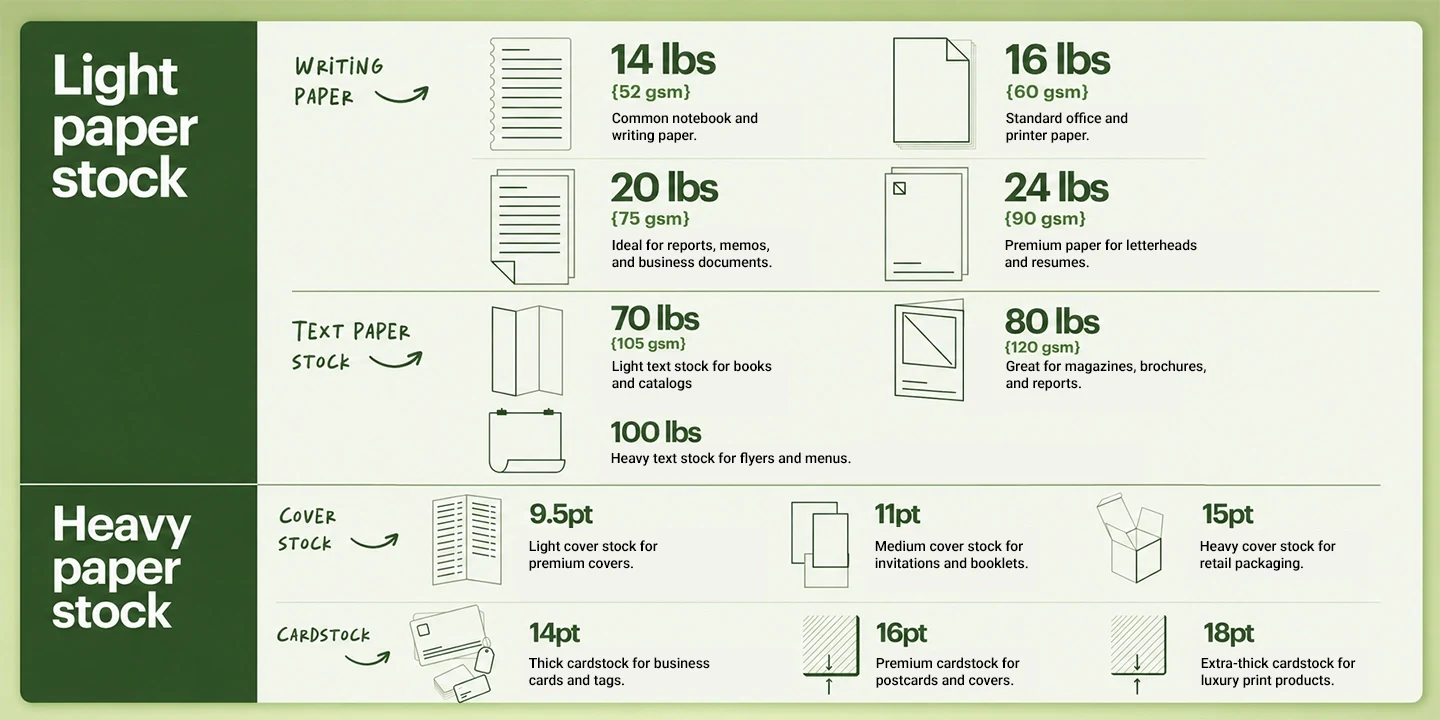
Light Paper Stock
-
Text Paper Stocks (89 to 148 GMS or 60 to 100 lb.): It gives you clean prints in full color, which suits books, catalogs, magazines, and art.
-
Lightweight Cardstock (157 to 190 GMS or 58 to 70 lb): This supports double-sided printing and is used for flyers, premium booklets, and presentations.
-
Midweight Cardstock (216 to 280 GMS or 80 to 100 lb): Brands use it for covers, postcards, and as marketing pieces, which makes it flexible yet durable.
Heavy Paper Stock
- Heavy Cardstock (298 to 352 GSM or 110 to 130 lb): An uncoated paper that gives a high-end, luxurious look, best used for business cards and postcards.
Extra Heavy & Specialty Stock (378+ GSM or 140+ lb)
- The most durable and rigid paper stock comes in handy for hardcover bookbinding, packaging, and mounting boards.
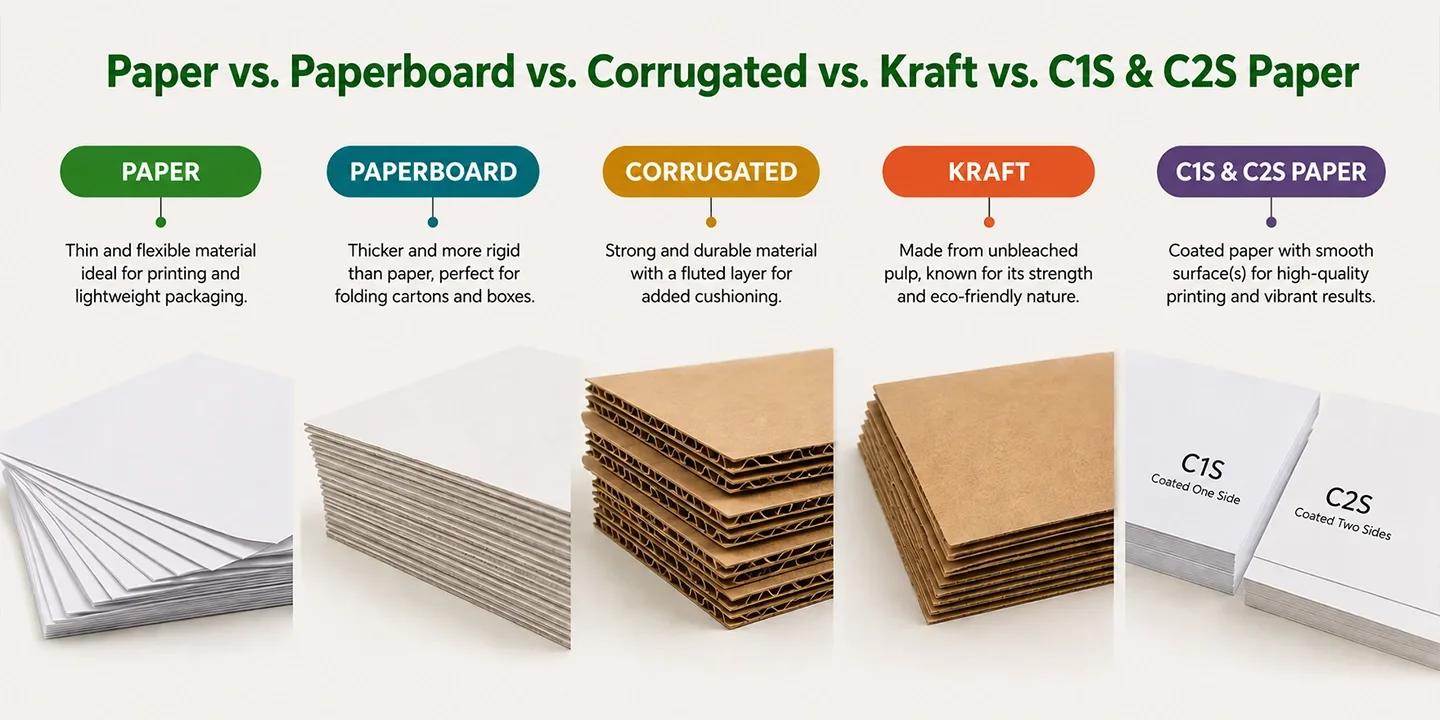
Paper vs. Paperboard vs. Corrugated vs. Kraft vs. C1S & C2S Paper
This table has more detailed terms and values that will help you understand how all these paper materials differ from one another. Now, packaging and other industries won’t get confused about which paper can help them in different situations:
| Paper and Board Type Comparison | ||||||
|---|---|---|---|---|---|---|
| Aspects | Paper | Paperboard | Corrugated | Kraft | C1S | C2S |
| Definition | Thin, flexible sheet with limited structural strength | Thick, stiff paper‑based board designed for packaging structures | Multi‑layer board with fluted medium between liner sheets | Strong, often unbleached material made from chemical pulp; can be paper or board | Coated One Side: one side coated for print, the other uncoated for glue/structure | Coated Two Sides: both sides coated for high‑quality print and finish |
| Thickness Range | ~0.04–0.20 mm (1.5–8 pt) |
~0.20–0.55 mm (8–22 pt) |
~1.5–7.0 mm (59–275 pt), depending on flute |
Paper: ~0.08–0.20 mm Board: ~0.20–0.55 mm |
Same as paper/paperboard; coating adds minimal thickness. | Same as paper/paperboard; coating adds minimal thickness. |
| Typical Weight Range | ~35–170 gsm | ~250–400+ gsm | Specified by flute type and board grade (not just GSM) | Paper: ~80–120 gsm Board: ~200–400+ gsm |
Coating weight is small; base stock drives GSM (e.g., 250–350 gsm board). | Coating weight is small; base stock drives GSM (e.g., 250–350 gsm board). |
| Typical Applications | Manuals, leaflets, labels, wrapping paper, inner decorative layers | Folding cartons, retail sleeves, cosmetic boxes, food boxes, hang tags | Mailer boxes, shipping boxes, e‑commerce packaging, protective inserts | Kraft paper bags, kraft mailer boxes, kraft folding cartons, wrapping, and void fill | Labels, tags, menu covers, and cartons needing one high‑print side and one glue‑friendly side | Premium cartons, cosmetic boxes, book covers, high‑graphic retail packaging |
| Strengths | Easy to print, fold, and bind; low cost | Good stiffness, printable surface, foldable with scoring | High cushioning, stacking strength, protection in transit | High tear and burst strength, natural look, eco‑friendly perception | Cost‑effective print quality on the front; back optimized for adhesive/assembly | Excellent print fidelity and gloss on both sides; consistent finish |
Packaging Paper Weight and Thickness Conversion Chart
Here’s a truth about all papers and sourcing packaging: your supplier hands in GSM, the factory speaks in pt, and others say in lb. Everything is in different measuring units. So it’s important to know how the conversion works with every figure you come across. Lucky for you, we have made it easy for you.
| GSM | Points (pt) | Thickness (inches) | Thickness (mm) | Thickness (Mil) | Recommended Packaging Applications |
|---|---|---|---|---|---|
| 10 GSM | 0.39-0.59 pt | ~0.00039-0.00059 inches | ~0.010-0.015 mm | ~0.39-0.59 mil | Tissue or release liners only |
| 35 GSM | ~1.4-1.8 pt | 0.0014-0.0018 inches | 0.035-0.045 mm | 1.4-1.8 mil | Very light wraps, tissue inserts, inner liners for delicate items |
| 45 GSM | 3.00-3.14 pt | 0.030‑0.032 inches | 0.76‑0.81 mm | 2.0-2.5 mil | Very light wraps, tissue inserts, inner liners for delicate items |
| 60 GSM | 2.75-3.35 pt | 0.032‑0.033 inches | 0.80‑0.85 mm | 2.5-3.0 mil | Lightweight leaflets, belly bands, dust wraps inside boxes |
| 80 GSM | 2.36‑3.50 pt | 0.002‑0.004 inches | 0.06‑0.09 mm | 3.0-3.5 mil | Product information sheets, thin kraft wraps, simple sleeve liners |
| 100 GSM | 3.14 pt | 0.003 inches | 0.08 mm | 3.5-4.0 mil | Sturdy leaflets, labels, stickers, light kraft paper for wrapping small items |
| 120 GSM | 3.93‑6.69 pt | 0.004‑0.007 inches | 0.10‑0.17 mm | 4.0-5.0 mil | Premium leaflets, packaging inserts, light-duty kraft sleeves |
| 150 GSM | 5.11 pt | 0.005 inches | 0.13 mm | 5.0-6.0 mil | Heavier brochures, hang tags (thin), inner dividers for small boxes |
| 180 GSM | 6.29 pt | 0.006 inches | 0.16 mm | 6.0-7.0 mil | Thick brochures, product cards, and stiff kraft wraps for gift boxes |
| 200 GSM | 7.08 pt | 0.007 inches | 0.18 mm | 7.0-8.0 mil | Light packaging cards, backing cards for small retail items |
| 250 GSM | 9.84‑13.77 pt | 0.010‑0.014 inches | 0.25‑0.35 mm | 9.0-11.0 mil | Light folding cartons, cosmetic sleeves, small retail boxes, hang tags |
| 300 GSM | 12.59‑16.53 pt | 0.013‑0.017 inches | 0.32‑0.42 mm | 11.0-13.0 mil | Standard folding cartons, cosmetic boxes, food boxes, medium hang tags |
| 350 GSM | 14.17‑19.29 pt | 0.014‑0.019 inches | 0.36‑0.49 mm | 13.0-15.0 mil | Premium retail boxes, cosmetic & skincare cartons, sturdy mailer sleeves |
| 400 GSM | 16.92‑22.04 pt | 0.017‑0.022 inches | 0.43‑0.56 mm | 15.0-17.0 mil | Heavy‑duty folding cartons, luxury beauty boxes, thick hang tags |
| 450 GSM | 23.62 pt | 0.024 inches | 0.60 mm | 17.0-19.0 mil | Rigid‑feel cartons, premium electronics packaging, high‑end gift boxes (paperboard layer) |
| 500 GSM | 26.37 pt | 0.026 inches | 0.67 mm | 19.0-22.0 mil | Extra‑stiff cartons, luxury packaging structures, thick specialty boxes |
How to Convert Different Paper Weight Units into Thickness Units
The US uses GSM or LBS as its main paper weight measurements. But if you live in another country, you should know how to convert these terms:
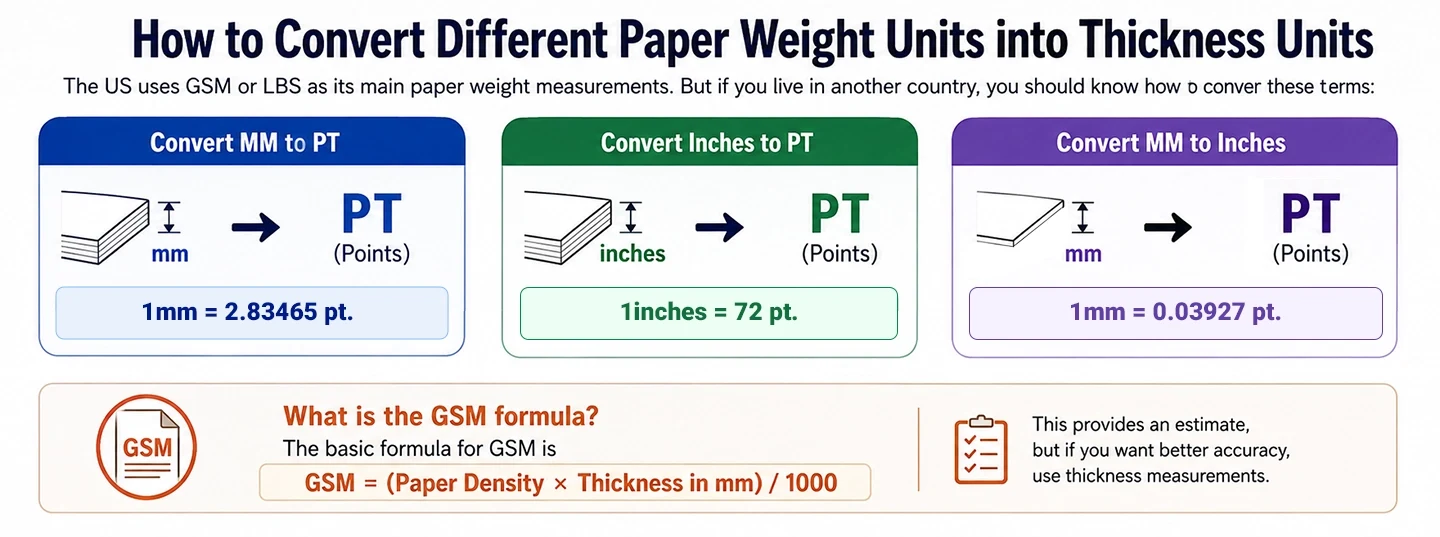
Convert MM to Pt
The formula for the simple conversion of 1 mm is equal to 2.83465 pt.
So, you can turn other values in such a way:
A paperboard of 0.60 mm thick would be 0.60 × 2.83465 = 1.70 pt.
Convert Inches to PT
Points are used for commercial printing, and their conversion formula is 1 inch = 72 pt.
So, to better understand how to turn a sheet with a thickness of 0.018 inches, multiply it by 72, and you’ll get 1.30 pt.
Convert MM to Inches
1 mm = 0.03937 inches is the basic formula for the paper weight and thickness.
You can turn a paperboard of 0.80 mm thick into 0.80 × 0.03937, which is then equal to 0.0315 inches.
What is the GSM formula?
The basic formula for GSM is (Paper Density x Thickness in mm)/1000, and this provides an estimate, but if you want better accuracy, use thickness measurements.
How To Choose The Right Paper Thickness?
For a brand, the right paper thickness choice can determine the product branding, how the inks will be displayed, and how much it will cost them. A well-balanced paper will deliver them a worthy production and shipping box.
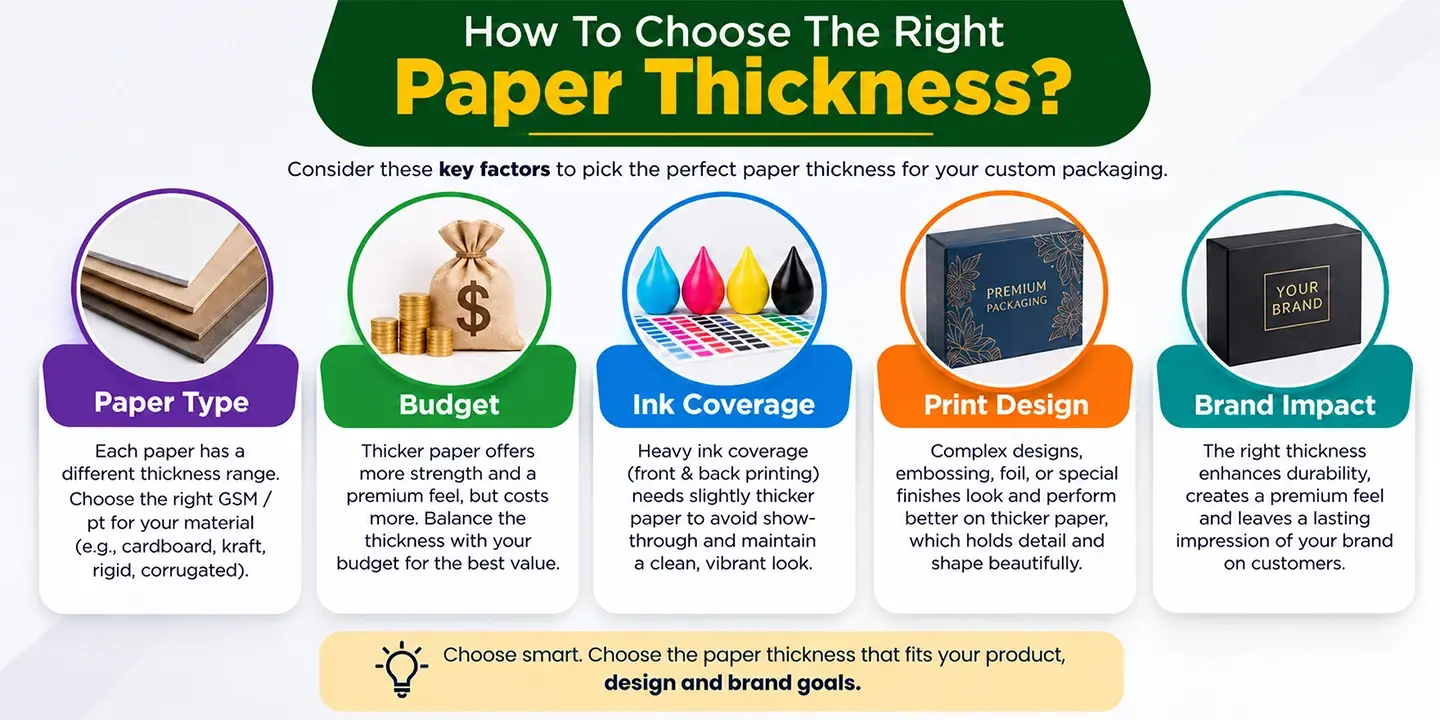
Paper Type
What paper are you using? Kraft or cardboard or paperboard or something else. They all vary in thickness, so choose wisely.
Budget
The thicker the paper, the more shipping cost you have to pay. A heavier stock offers a premium appearance and better durability, so naturally it costs more.
Ink Coverage
Your brand should use a thicker paper stock, as it has larger ink coverage and gives you detailed graphics in bold colors. There is less ink bleed, and it provides high-dimensional stability.
Print Design
Whether you want to print a brochure, catalog, or booklet, it requires flexible stock. You can use a heavier stock for packaging or postcards.
Brand Impact
If you want a premium brand look, use the thick stock that creates a high-quality feel and showcases how professional and luxurious it is. With lighter stock, you can go for cost-effective projects.
Choose MyBoxPrinting to Create Premium Custom Packaging
Paper weight and thickness provide packaging manufacturing companies with how a single value of paper can change its composition. Also, if you choose the right values and paper, you can create the best custom packaging solutions, whether it’s a box, bag, business cards, Mylar bags, and so much more. MyBoxPrinting should be your only choice.
Frequently Ask Questions About Paper Weight & Thickness
How does the thickness of the paper matter in the printing quality?
The print quality depends on how it handles the ink, whether it prevents ink bleeds, and whether it gives you a high-end-quality look.
Can I use heavy cardstock in a home printer?
It is difficult, as most home printers can only print around an 80-110 lb cardstock (roughly 200-300 gsm). Otherwise, the stock will jam.
What paper weight is most eco-friendly?
The paper weight isn’t considered economical; it’s about whether it is recycled or FSC certified. So the lighter the paper weight, the less material is used in it.
Why do paper weight numbers vary between the U.S. and other countries?
The U.S. uses a “lb” (pound) weight system, which is based on an uncut parent sheet. Other countries use a "GSM" system based on a 1x1 meter sheet.
Can I mix paper weights in one project?
Yes, it can increase the standard of the paper for different items like booklets, multi-page menus, etc.
What paper weight is best for double-sided printing?
If it’s about a general text document, then 24 lb to 32 lb bond paper is the best. For heavy colors, flyers, and brochures, you should use 70 lb to 80 lb text paper.
Can paper weight affect mailing costs?
Of course! A heavier paper adds weight to the mail, and it will cost you more to ship it.
What paper weight and thickness are best for different projects?
Whatever your project is, know these are what you can order with confidence:
-
Flyers: 70 to 100 lb text
-
Brochures: 80 to 100 lb text
-
Booklet covers: 80 to 100 lb. cover
-
Magazines: 80 lb text interior, 100 lb cover
-
Business cards: 100 lb cover and up
-
Postcards: 100 lb cover
Final Thoughts: Choosing the Right Paper
The right paper weight and thickness determine and balance the structure, offer protection, and offer visual appeal and the overall efficiency of the production. This blog discussed how these two terms are measured and what type of material offers how much weight and thickness. If you want your packaging to hold the product, hold strong print colors, and other finishes, use our services. At MyBoxPrinting, our manufacturing experts know exactly what you need. Contact us today!