History is the witness to the cruelty of humans towards natural resources. They have been continuously exploiting the natural resources for their own benefit. Now the resources are at a point where they are on the verge of depletion, leaving the world empty-handed.
But isn't it concerning how we reached the point of endless wants and needs?
Over centuries, a number of large areas of virgin forest were cleared for timber, paper, and packaging purposes. With the start of industrialization, most importantly after the Industrial Revolution, the extraction of resources increased dramatically.
It has been observed that with the start of the 21st century, the developed countries have depleted a large amount of forests and polluted land and water with plastics. This has become a much greater concern. But the most threatening factor is that environmental harm is taking over the globe.
Making damage from marine life to biodiversity loss, this overuse of plastic, like non-biodegradable materials are causing serious problems. This serious threat can be resolved by just going in straingth line; it takes something more. That something more is a closed-loop circular economy.
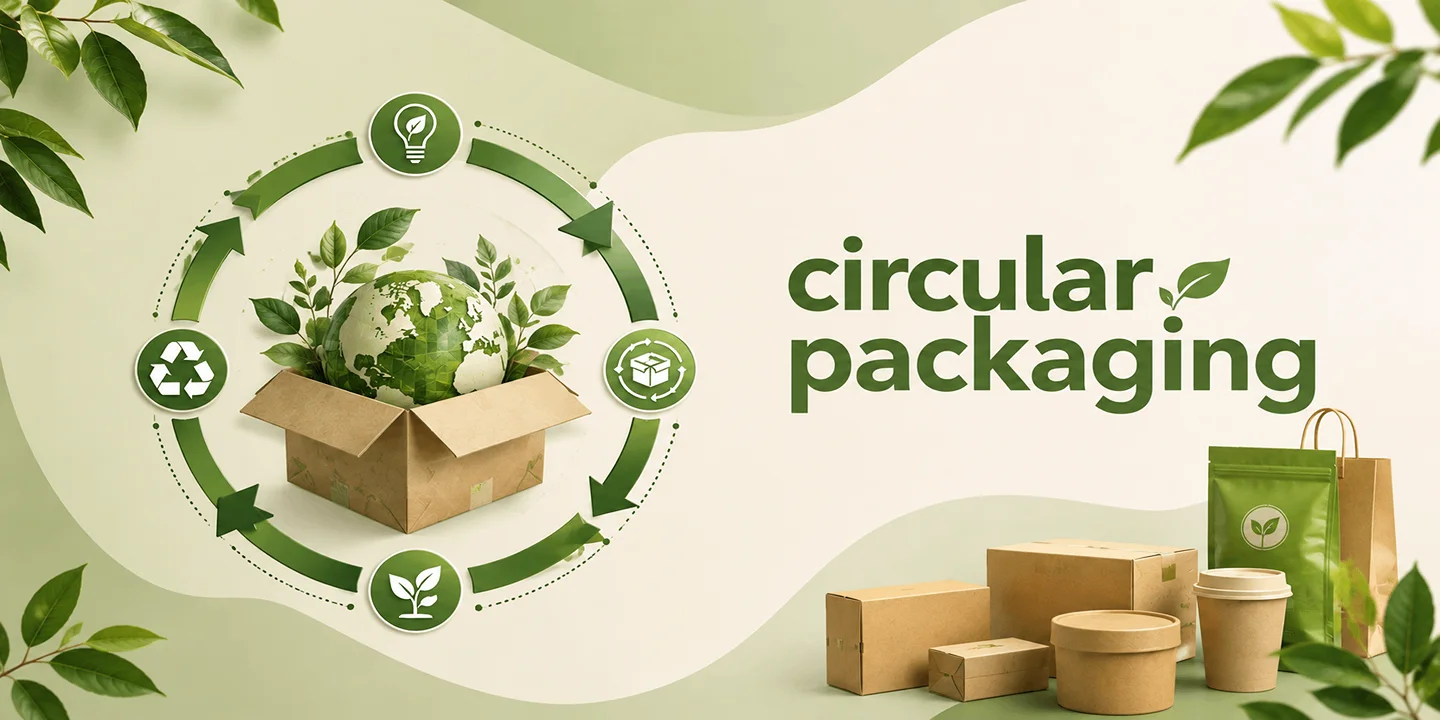
In this guide, we will come across the concept of circular packaging. How it transforms the traditional “take-make-waste” model into a more sustainable and closed-loop system. We will also explore the concept of how the biological and technical cycles work and how packaging materials can be reused and regenerated.
Moreover, this guide will also help you learn how you can adopt circular packaging in your business to reduce waste. You can play your part in making the planet cleaner and cleaner for you and your eco-conscious customers. Moreover, at MyBoxPrinting, we can help you increase your customer satisfaction.
What Is Circular Packaging? A Better Understanding
Circular packaging is an eco-friendly method that is designed to reduce waste by keeping packaging materials usable for a longer period of time. This is done by practices like reuse, recycle, and regeneration (the 3Rs). These green strategies create a closed-loop system. In this, the packaging materials return to production cycles as reusable resources. Moreover, these durable practices also make sure that the resources return to the environment after completely decomposing without causing any harm.
Circular packaging is basically a solution that is designed to reduce the virgin, non-recycled, raw material consumption in packaging manufacturing. These solutions are conservation-minded approaches, including reducing manufacturing waste, incorporating recyclable materials, or employing biodegradable materials. Moreover, you can also restore the habitat of many living species.
Example Of Circular Packaging
Circular packaging is basically a responsible approach that is used to achieve eco-friendliness. There are different examples of strategies that are being adopted worldwide to make your packaging circular.
Using fewer materials in the smart packaging designs:
When you use less material, you actually save more resources. In this way, you play your part in saving the resources for the next generation.
Reusing packaging for longer periods of time:
When packaging is made durable and long-lasting, it can be used multiple times before it needs to be recycled. This reduces the waste and reduces the carbon footprint in the environment as well.
By using recycled materials:
In the packaging industry, there are many materials that go to the trash and are disposed of after being used once. But if you design your packaging in a recyclable way. It can help cut down on trash and use fewer new resources in making the new one, and old packaging can be recycled.
Using biodegradable materials:
There are some packaging materials that can naturally break down without harming the environment. The best example of such materials is decomposable and compostable cardboard materials. This is used for fresh food containers. These are made from products like recycled plastic, mushrooms, and algae.
Note: All these are advanced technologies that are used as a proven solution for improving sustainability.
How Circular Packaging Is Associated With Circular Economy?
The circular packaging is a key goal of the circular economy. The circular economy is a business system that deals with the processing of products, materials, and resources. In this system, these are reused, repaired, refurbished, or recycled instead of being thrown away. In many cases, recycled plastics can be made to meet FDA regulations for food contact safety standards. By using PCR materials, we can reduce our dependence on raw fossil fuels and lower energy consumption. This gives us more eco-friendly material that is sustainable and is compostable.
But what is the purpose of this whole system?
The main goal is to reduce waste and increase the life of products. It also uses resources more efficiently. Instead of dumping used plastic into landfills, it is gathered and sorted. After that, it is washed and mechanically recycled. The next process is melting and converting into pellets. These pallets are mostly used by manufacturers to produce new plastic products and packaging.
The process takes place in a circle instead of a straight line, creating a “loop”. It starts from the point of production and goes to disposal. This closed-loop process shows how many common plastics can be reused multiple times. Through this, not only is the material maintained, but its functional performance also gets better.
The best examples of the circular economy are cardboard and kraft paper. In addition, PCR (post-consumer recycled) plastic is collected after people use it for reprocessing. It enters the production cycle in a very simple process.
We know that the recycling system is not perfect yet, but the permanent practice of recycling plastics can help reduce billions of pounds of waste from landfills. And it will also support progress towards a circular economy. According to the research done by the U.S. Plastic Recycling Study from Stina and the Association for Plastic Recyclers on plastic recycling. In 2022, more than 5 billion pounds of post-consumer plastic were recovered for recycling. [Report Credit: Plastic RecyclingFacts]
The importance of the circular economy can be understood by how it is reducing total annual greenhouse gas emissions. According to the United Nations’ Internal Resource Panel, about 50% of greenhouse gas emissions come from natural resources. These virgin resources are extracted from the earth, like oil, gas, and minerals. We can reduce this pollution level by using recycled or already used materials instead of using raw materials. This will create fewer energy levels and emissions. Moreover, the carbon footprint will also decrease.
Waste Management Within A Circular Economic Model Through Butterfly Diagram
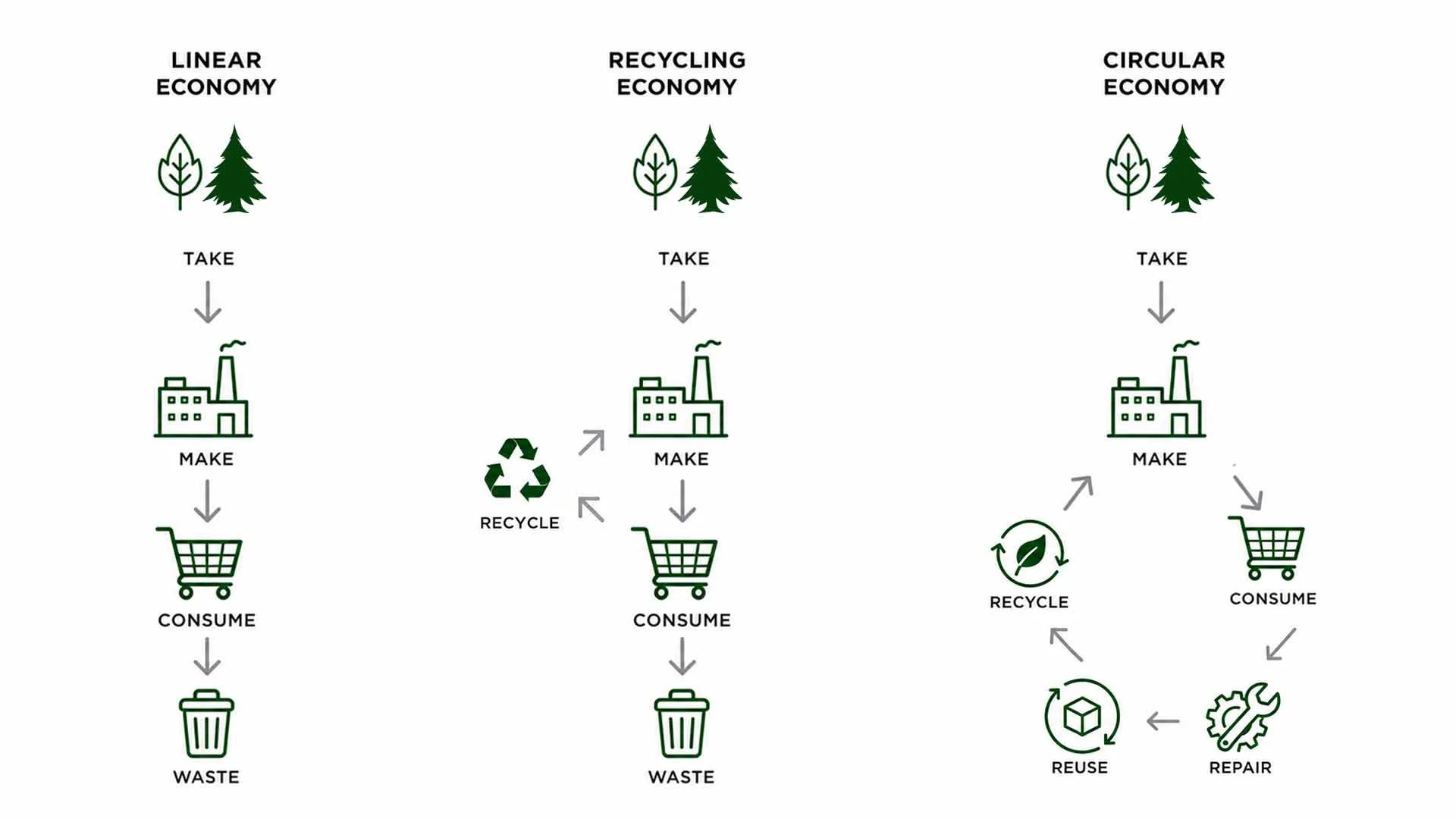
A circular economy is also known as the cradle-to-grave model. It is a more sustainable way of producing and using goods. It is different from the traditional cradle-to-grave system. In a cradle-to-grave system, the raw materials are taken from the earth, and they are turned into products. After they are used for a short period of time, they are thrown away as waste.
In that old system, once a product reaches the end of its life, it usually ends up in the landfill or is burned. This causes pollution and wastes valuable resources. A circular economy keeps materials and products in use for a longer period of time. It focuses on the process, starting from the production to disposal in a continuous loop.
The Ellen MacArthur Foundation introduced the butterfly diagram. This diagram clearly explains how a circular economy works. The diagram shows the two main cycles:
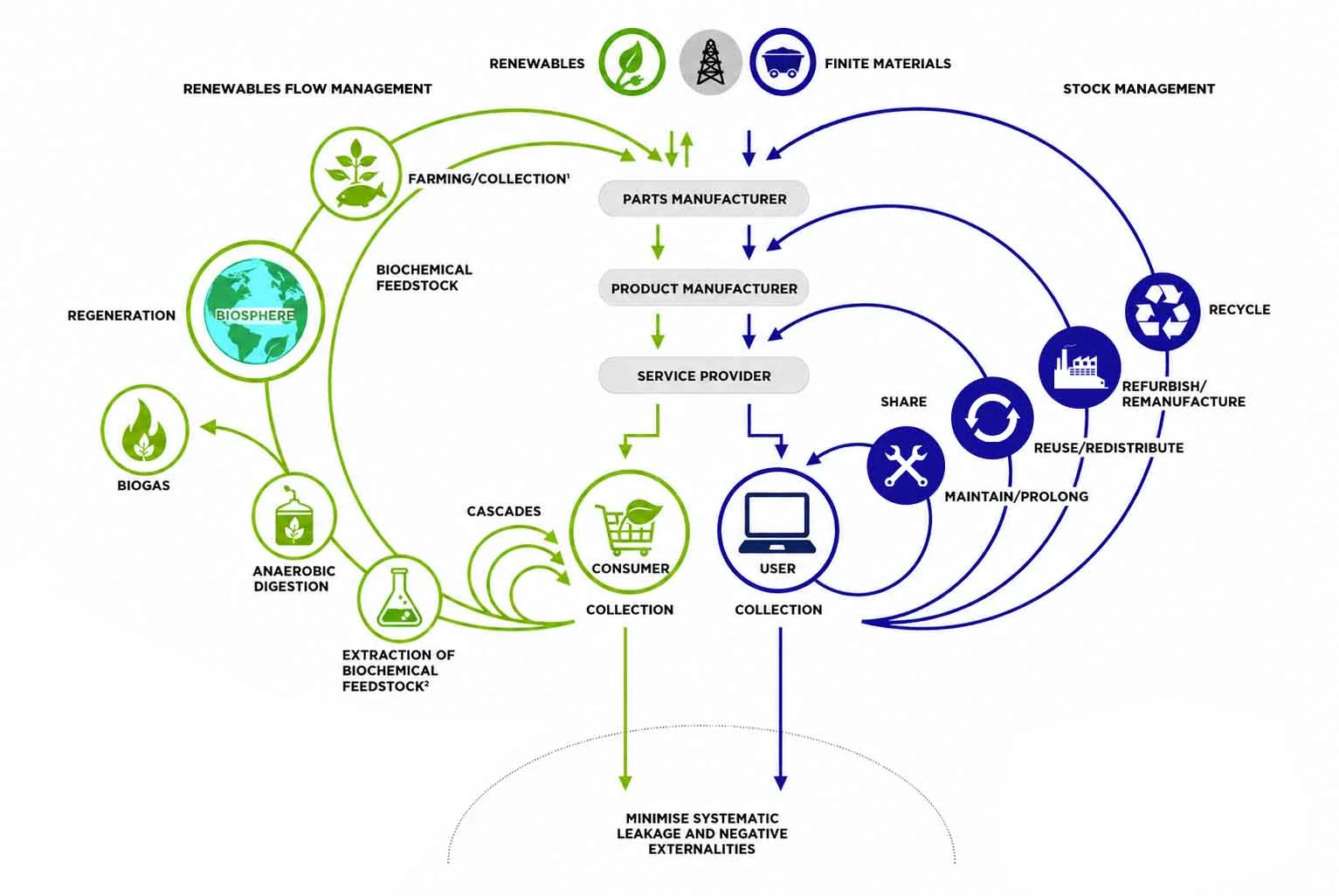
One is the technical cycle,
And the other is the biological cycle.
The main goal is to reduce waste and lower pollution. Furthermore, it also improves the use of natural resources. From the designing of products to be used again to the repair of them, the circular economy plays an important role in every niche. Moreover, products are also refurbished or recycled instead of being discarded.
The butterfly shape represents how materials flow continuously through these systems instead of becoming waste. This diagram also highlights different strategies for extending a product's life. These strategies include maintenance, reuse, remanufacturing, and recycling.
The technical cycle deals with non-biodegradable material. These include metals, plastics, and electronics. In this cycle, products are kept in a loop as long as possible.
For example, instead of throwing away a broken box, it can be recycled. If it cannot be recycled, it can be processed or manufactured into new products. And when a product finally reaches the end of its life, the material can be recycled and used again to make something new. This reduces the need to extract fresh raw materials and lowers the environmental damage.
The biological cycle deals with biodegradable materials. The materials include natural fibers, paperboard boxes, and organic matter. All these materials are returned to Earth after use. That is done by following the process like
-
Composting
-
Anaerobic digestion
-
Natural decomposition
In this way, biological materials regenerate natural systems in which they safely return nutrients to the soil instead of polluting it. Through these processes, such as composting and natural decomposition, the materials re-enter the biosphere and contribute to soil health.
Moreover, it also increases agricultural productivity and ecosystem restoration. The circular economy is important because it replaces the take-make-dispose logic with the restorative and regenerative model. In this model, waste is not treated as an inevitable outcome, but this system designs waste from the very beginning. The products and materials are intentionally created to circulate in closed loops. This is done by biological regeneration or technical recovery, and the circular method.
The circular economy changes the focus from short-term usage to long-term usage. It ensures that the material remains a productive asset rather than becoming an environmental burden.
Introduction of the Circular Economy By Ellen MacArthur Foundation
The Ellen MacArthur Foundation introduced an economic model that introduced a system of "take - make - reuse - return" instead of "take – make – waste."
According to this model, we need changes that can keep the products in use longer to create eco-friendly and sustainable production. For example, plastic boxes that are used for packaging are often disposed of after one use. They must be replaced with a more sustainable option, like paper pulp boxes. This system not only makes sure that natural resources are saved. But they also reduce dependence on plastic, which causes landfill overflow and pollution.
But how can it be done, and what alternative do we have to bring about the change? "The answer is circular packaging."
This model is designed to keep the packaging in use for as long as possible, and after the end of its life, it must be returned to the earth. Moreover, it also reduces the extraction of new natural resources.
The Explanation Of The Butterfly Diagram
The diagram has two sides: The left side is greener, and the right side is the technical side. The middle portion explains users and service providers.
Left Side: The Biological Cycle
The left side is about the things that come from nature. This side explains renewable and natural materials. The flow components are given below
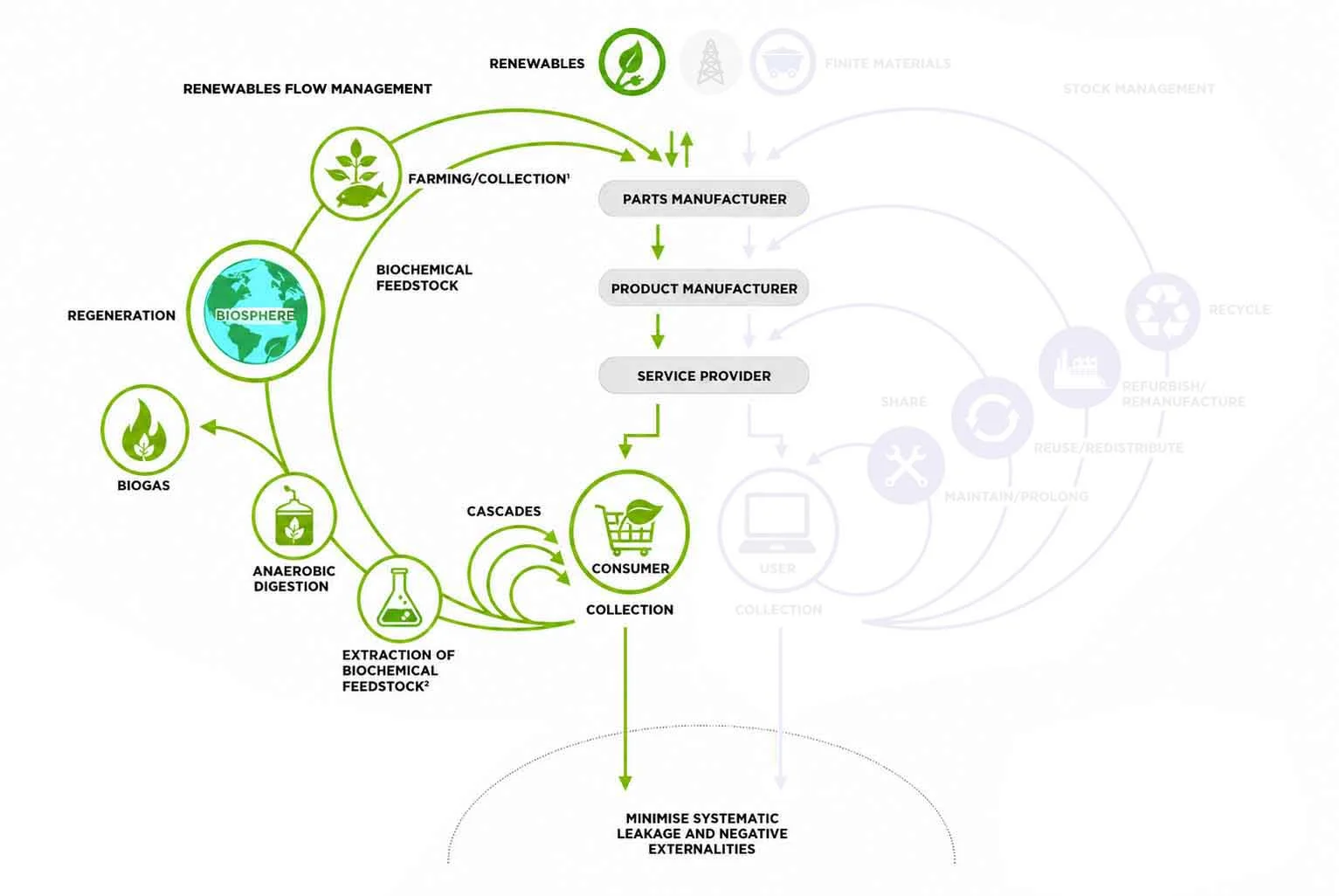
Farming / Collection
Farming or collection on the biological side of the diagram starts with the farming or collection of the natural resources. This includes plants, timber, natural fiber, and other organic materials. The very important point here is to note that these resources are renewable. This means that they can be grown naturally again over a period of time.
Biochemical Feedstock
After the farming step comes the biochemical feedstock, in which some natural materials are processed to form biochemical feedstock. The biochemical feedstock is the conversion of natural materials into raw biological ingredients. These are used to produce materials such as biobased plastics. It also produces some other materials, like natural fibers or organic packaging.
Manufacturing
In the manufacturing part, the collected biological materials are used to make the products. There are different types of products that are produced from these materials, which include food products and paper packaging products. Moreover, compostable packaging, cotton textile, or other biodegradable goods are also manufactured during this process.
Distribution and Use
After the manufacturing, the distribution and use of those products occur. The finished products are distributed to consumers, and they use them. At this stage of the diagram, it shows that the products are used for the purpose they were consumed, just like the traditional economy.
Collection After Use
Once the products have been consumed, they are properly collected instead of being sent to landfills. After the collection, they are separated in the collection system to make sure that the biodegradable materials are kept away from other materials, which are non-recyclable waste.
Cascades
Before dumping the renewable resources into the earth, these biological materials go through cascades. Cascade is a process in which the materials are again used in many different ways to extract maximum nutrients from them. The best example of this can be seen before making the compost of biodegradable packaging cartons. They are soaked in water to extract maximum tree pulp from them, which is then cleaned and converted into a new packaging box.
Anaerobic Digestion / Composting
After the cascade, the leftover material, which cannot be used again, becomes the compost for many biological treatment processes. For example, anaerobic digestion. In this, the leftover material is broken down naturally, and it produces biogas that again becomes a renewable energy source.
Regeneration
The nutrients from the broken-down material return to the soil, and that improves the soil's health. Moreover, they support the growth of new plants, which restarts a cycle, making a complete loop again
Right Side: The Technical Cycle
The right side of the diagram focuses on finite resources, which are also known as non-biodegradable materials. These materials include metals, plastics, electronics, or synthetic materials. These materials are those that cannot return to nature, and they are used again and again to maximize their life span.
The main goal of the diagram is to keep them circulating in the economy as long as possible. The flow components are given below.
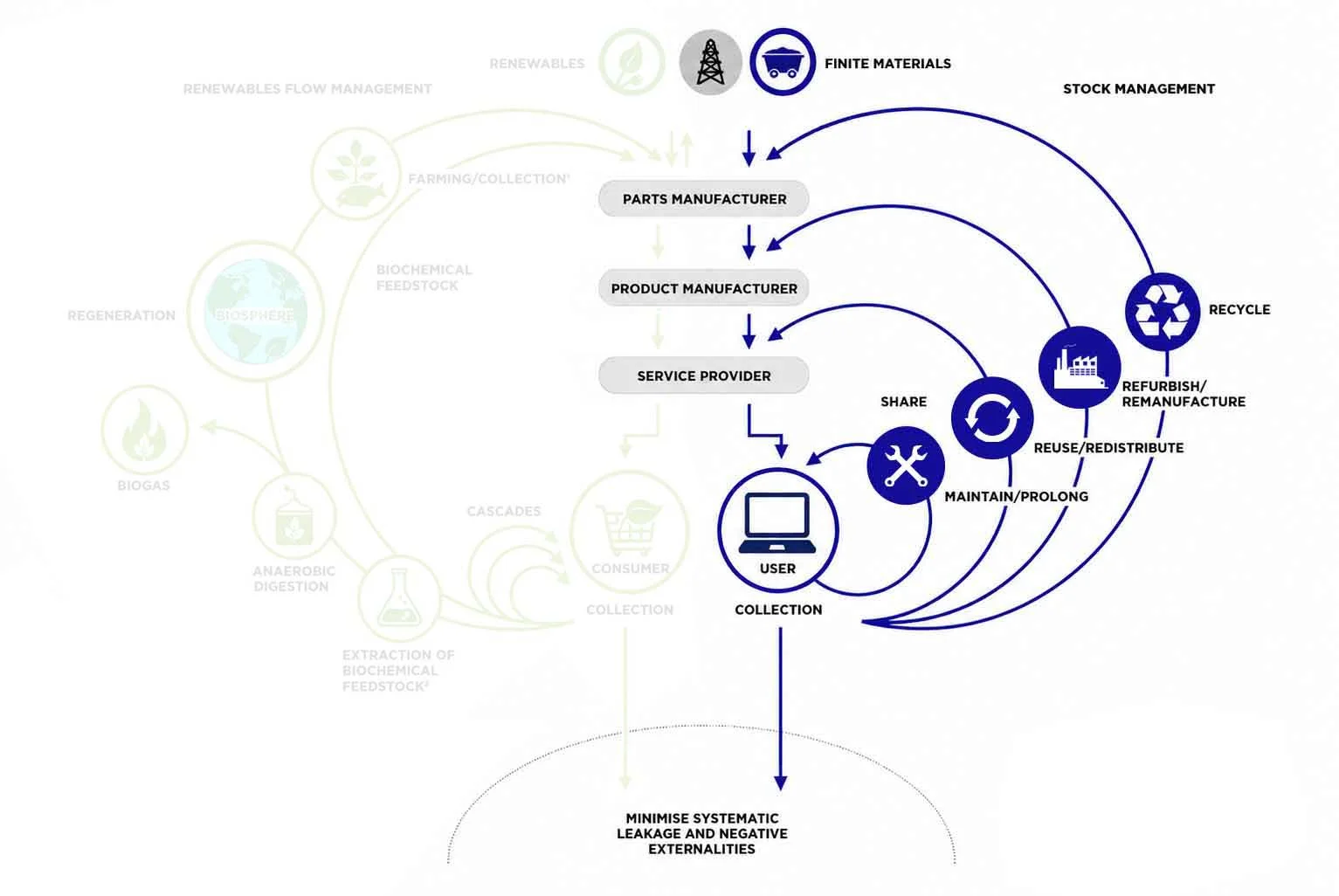
Extraction Of Finite Materials
The cycle of the right side starts with the extraction of raw materials. These materials include metals, minerals, and fossil-based resources. It is very important to reduce the use of these new materials because these resources are very limited. They must be extracted as per the requirement.
Share
In the sharing, the products are shared among different users. This increases the usage of the products without making new products. For example, Gaylord boxes, which are rented or resold again. A similar example is of shipping boxes.
Maintain / Prolong
Maintained or prolonged stage ensures that the products are repaired and maintained. This increases their life, and they can be used multiple times. This reduces the waste.
Reuse / Redistribute
In this step, if the original consumer does not need the product. They can resell it or redistribute it to another customer who can use those boxes. For example, after using the rigid boxes that come with premium products, they are sold by the shopkeepers or by the customers online as gift packaging.
Refurbish / Remanufacture
When the products are completely damaged or outdated, they cannot be made again. Then some people restore or upgrade those products to like-new condition. This saves material and energy that would be spent on manufacturing the new one.
Recycle
Recycling is the final step of this loop in which the materials are broken down into raw form. In this step, the materials that cannot be used again are broken down into scraps, and they are used in manufacturing the new products.
It is a very important step because, though recycling is less efficient than reuse or remanufacturing, it is done because no other option is left.
The Inner Circular Loops (Keeping Products In Use)
After the whole circle completes, the inner circular loop comes. It has the main purpose of keeping the materials circulating as long as possible. This is a very small loop, which makes sure to preserve the resources. The main components of this loop are given below.
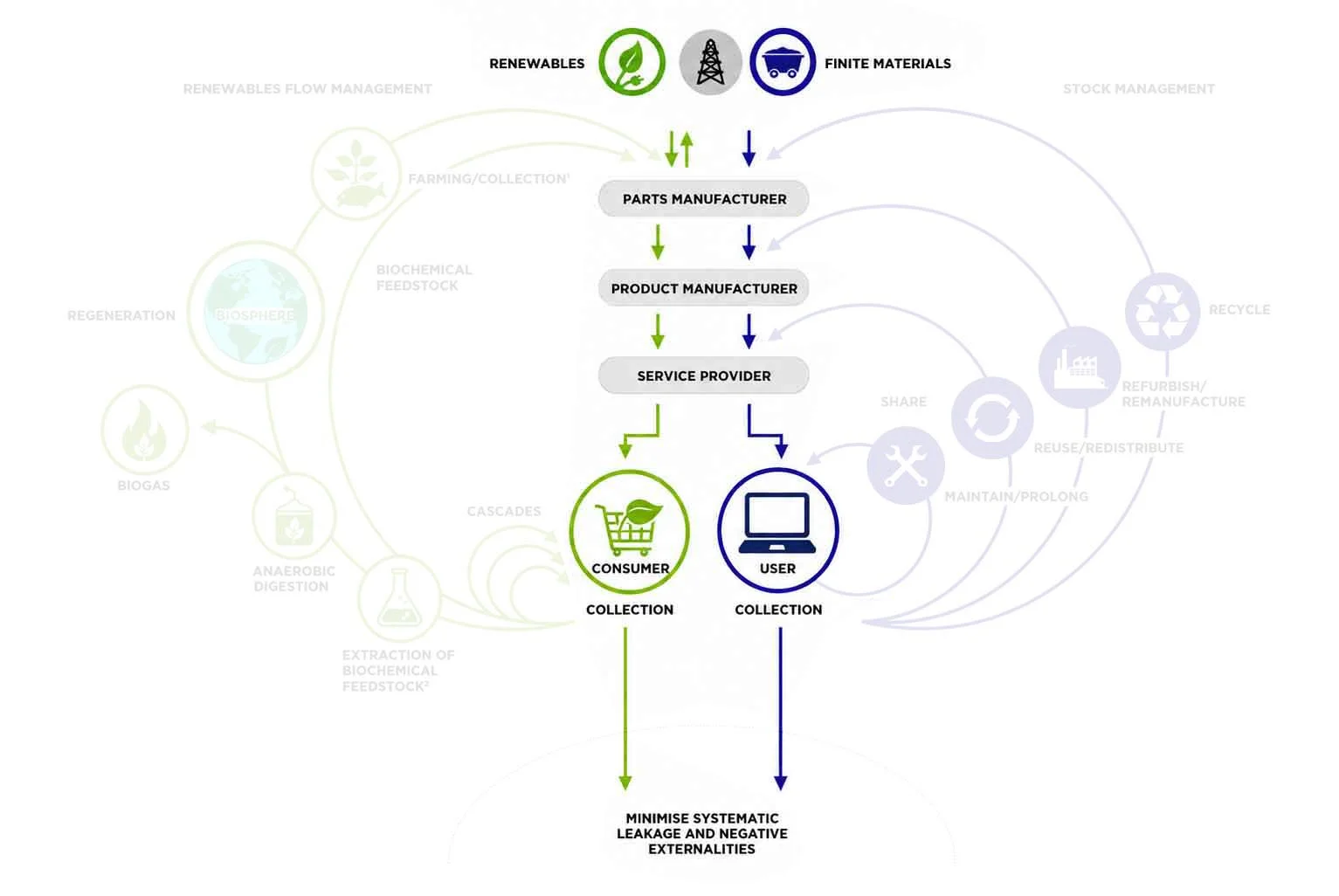
Parts Manufacturing
After the extraction, the material is processed to make the components or parts. For example, the plastic may be molded to form Mylar bags or PVC windows for the packaging material in product manufacturing.
Product Manufacturing
After the parts are manufactured, the next step is where all these parts are assembled to form a finished product. For example, custom packaging inserts, PVC windows, mylar bags, or polyethylene bags.
Service Provider / Business Model
After the manufacturing, the products are completely ready to be delivered to the consumers. This is done in two ways, either through direct sales or service-based models.
This step is very important and shows a change of production to consumption. This encourages longer product life.
User
The product is then delivered to the customers where it is used, and the main focus is on the proper maintenance to increase the product's lifespan
How The Middle Connects Both Sides
The middle section of the diagram is a point that determines which product will enter which product after its use.
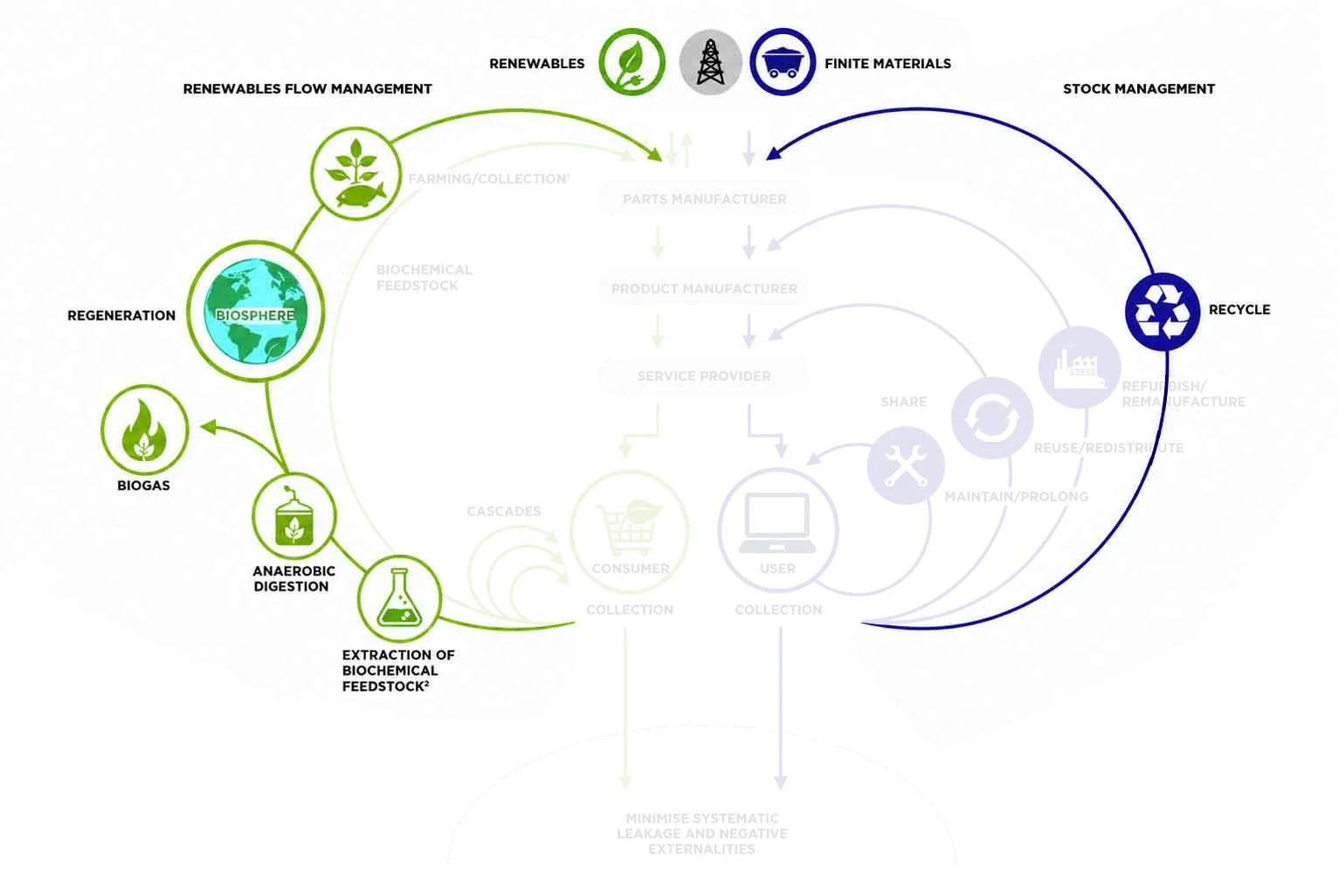
If the product is biodegradable → it flows back to the biological side for regeneration.
If the product is durable and non-biodegradable → it flows back to the technical side for reuse or recycling.
In short, we can say that the middle is the control center of the circular economy. It is a section that links production, usage, and recovery. It makes sure that materials return to the correct cycle and do not become waste.
Overall Purpose Of The Diagram
The overall purpose of the butterfly diagram is to reduce the waste of products and keep using them until they can no longer be used. In this diagram, the resources produced by nature are discussed in the biological cycle. Whereas the technical cycle is all about saving and recycling non-renewable materials.
These two sides are connected systems to reduce the environmental impact and resources saved. They also make sure that materials do not leak into landfills or cause pollution.
The diagram demonstrates how the circular economy replaces the linear packaging with the take, make, and dispose model in a continuous system in which the materials remain in productive use and natural systems are restored rather than wasted.
What Is The Difference Between Linear and Circular Packaging?
The main difference between linear packaging and circular packaging is very basic.
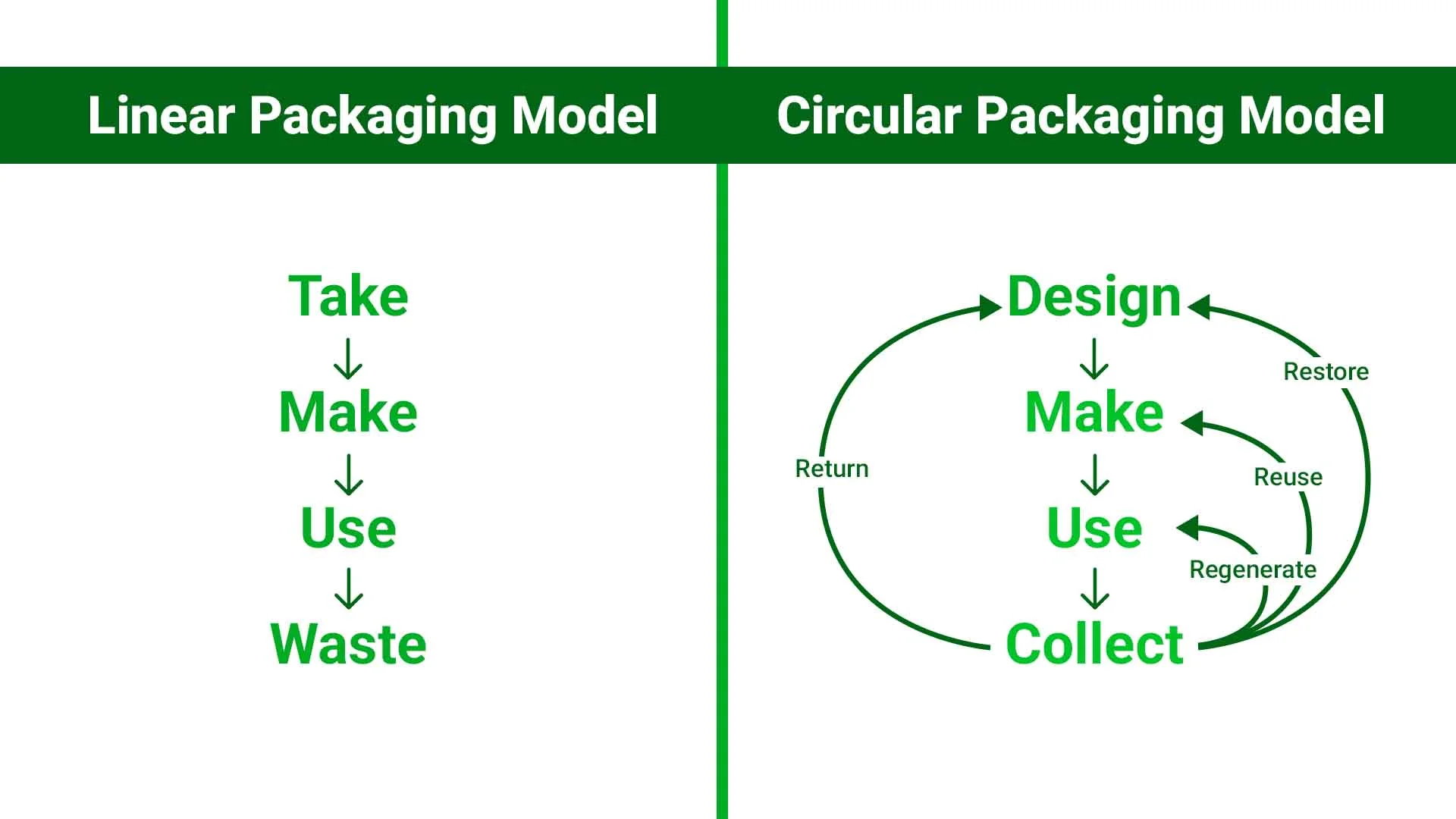
The linear packaging model follows the method in which
-
Brands of different products take the material
-
They manufacture the packaging
-
Their consumer use it
-
After usage, the packaging is disposed of.
Linear Model: "Take - Make - Use - Waste"
It is a very traditional system that most businesses have used for years. It works simply by extracting the raw material for manufacturing the packaging for the products. After use, that same packaging is thrown away. It is one straight line that has no coming back.
The most common examples are plastic snack wrappers that are used once and thrown in the bin. In the packaging industry, there is one more notorious example nd that is of non-recyclable laminated boxes that are used once and thrown away.
But in the circular packaging model is different. Circular packaging follows the loop method, in which there is a very simple rule:
"What is taken must be returned."
In circular packaging, the packaging is specially designed to be reused or recycled. Once the packaging is used, it is reused, refilled, recycled, or composted. In this way, the materials go back into production. This makes a whole loop or a circle, and it's not a straight line. The best example is refillable glass jars, FSC-certified recycled cardboard boxes, etc.
Circular Economy: “Design - Make - Use - Collect - Return - Restore - Reuse - Regenerate”
Circular Packaging Vs. Linear Packaging
Both packaging models are different from each other, from design to the way they are disposed of. The main goals of both packaging determine their importance and differences. Below are some key differential points on the basis of which both can be better understood.
Design
The main focus of linear packaging lies on factors such as cost and features of the packaging. But the circular economy packaging is a practical presentation of reducing the amount of material that is used. Moreover, it also ensures that the material that is used is recyclable or is taken from a source that is made from recycled content.
Raw Material
Linear packaging is manufactured from raw materials like wood, metal, or plastic. Whereas circular packaging is made from processed recycled material that is biodegradable and more eco-friendly. This factor also affects the energy cost and consumption. In linear packaging, the energy cost is very high compared to circular packaging, which has a lower energy cost.
For example, recycled material has an energy consumption 79% less than plastics.
Material Qualities
In linear packaging, the companies choose new raw materials on the basis of how they want their final product to look and perform. So if they want strong packaging, waterproof or shiny packaging, they will just pick new materials that will give them those features.
But in the case of circular packaging, companies do not use new material. Instead, they use recycled material. And if that is not working alone for them in terms of strength and performance, they sometimes mix recycled material with some virgin material to get the right strength, quality, and appearance.
Waste
In linear packaging, the boxes and packaging of brands have the final destination towards landfills, or worse, they can be dumped in the ocean or waterways. Whereas for those brands that follow circular packaging, their boxes are made into new packaging or other products. They start a cycle as a raw material for some other kind of packaging.
Note: It is very important to know whether packaging is recycled by processing in the industries or biologically through the natural decomposition of biodegradable material. It returns its nutrients to the ecosystem, playing its part in saving the planet.
Linear Economy Materials Vs Circular Economy Materials
The linear economy materials are those that follow the "take-make-waste" model. In this model, the materials are taken from the resources and used. After use, they are discarded, which leads to landfills and environmental pollution. In some cases, this disposed of material is also incinerated, which leads to air pollution.
These materials are used for a very short period of time and are made from raw materials that are virgin. These materials are not recommended for use because of their negative impact on the environment, such as environmental degradation, high greenhouse gas emissions, and resource depletion.
The best examples of such materials are single-use plastics, fast fashion, disposable coffee cups, and unrepairable electronics.
The circular economy materials follow the “Reduce - Reuse - Recycle” model. Which means that the materials are taken from recycled or reused materials. After processing it, the material is repaired and remanufactured to make a new material. This material is the best option due to its durability and reliability. This material is repairable due to its recyclable nature. This makes it 100% recyclable.
This material has a positive impact on the environment, such as a lowered carbon footprint, reduced pollution, and increased resource efficiency. The best examples of this material are modular electronics (designed for repair), recyclable glass, biodegradable packaging, and refurbished machinery.
Key Differences Between Linear Packaging and Circular Packaging
If you want to start working as a part of the circular economy, then you need to understand the basics of sustainable practices. The difference between linear and circular economy is a better way to get a clear idea of where they differ from each other. The table below is based on several factors that give a clear image of their differentiation from each other.
| Linear Economy vs Circular Economy | ||
|---|---|---|
| Feature | Linear Economy | Circular Economy |
| Material Flow | Linear (Take – Make – Dispose) | Closed-loop (Reduce – Reuse – Recycle) |
| Lifecycle | Short-term / Disposable | Long-term / Service-based |
| Waste | High (Landfill / Incineration) | Minimized or Eliminated |
| Resource Source | Constant new extraction | Renewable and recycled inputs |
| Product Design | Designed for single use | Designed for durability and reuse |
| Material Types | Virgin materials (plastic, metals) | Recycled, biodegradable, and eco-friendly materials |
| Production Approach | Mass production with waste | Efficient production with minimal waste |
| Environmental Impact | High carbon footprint | Reduced environmental impact |
| Cost Efficiency | Short-term savings | Long-term cost benefits |
| Customer Role | End user (disposal) | Participant (reuse, return, recycle) |
| Business Model | Sales-focused | Service and sustainability-focused |
| Packaging Use | Single-use packaging | Reusable, recyclable, or compostable packaging |
The table clearly shows that linear packaging provides ease and speed to its adopters,s but this model promotes a higher level of waste and resource depletion. On the other hand, the circular economy offers its adopters sustainability and keeps the material in use for a longer period. Moreover, it also reduces the waste level.
Circularity Under EPR Policies: A Step Towards Planet's Betterment
“Sustainability doesn't come just by thinking. It comes by targeting your goals towards it.”
Most importantly, they are aligned with extended producer responsibility (EPR) policies. Now, the most important question arises: what is ERP?
The answer is that it is a policy framework that has the main goal of changing the responsibility for managing the product life cycle from consumers to the producers themselves.
EPR keeps producers responsible for what happens to their packaging after it has served its purpose. It tells them that it shouldn't just become someone else's problem to deal with. It is their responsibility to know how to discard that. Almost everything that is sold online or in stores has some kind of packaging. Whether they are packed in boxes, plastic wraps, or bags, all of these materials are dumped after being used once. And they become waste; a large part ends up in landfills.
The EPR approach encourages brands and businesses to manufacture the products and packaging that have end-of-life in mind. It should be focused on reducing waste and promoting reuse. Moreover, EPR also prioritizes recycling to minimize environmental footprints.
But the main question is whether it is possible to make that packaging more than just a waste? The answer lies in the fact that there are different kinds of packaging that can be used to recycle waste into something valuable for our planet. In this type of packaging, the materials like Kraft paper break down into rich nutrient compost, while corrugated cardboard and rigid stock are easily recovered for circular reuse. They do not accumulate in landfills. It can become a perfect example of EPR and presents a more sustainable and responsible way of product packaging.
Biodegradable and compostable packaging goes hand in hand with EPR's main goals in several ways.
It minimizes the waste to a great level by keeping the products in use for a longer time. Due to this, the renewables stay in use, and after disposal, they are managed properly. This system teaches brands to take responsibility for the complete life cycle of their product. Moreover, it meets consumer demands, and it contributes to a circular economy.
Why Is The Circular Economy Important?
The circular economy is leaving behind the conventional methods of the linear economy model, which promotes throwing away. To conserve our resources for future generations, it is mandatory to go for a circular economy. This will protect our environment and reduce biodiversity loss.
In addition to these benefits, a major advantage of the circular economy is that it reduces the annual greenhouse effect and greenhouse gas emissions. According to the report of the United Nations’ Internet Resource Panel, the continuous withdrawal of natural resources is increasing greenhouse gas emissions by almost 50%. This level can only be reduced if recycled materials are used instead of new raw materials. This will also create a very sustainable environment.
What Are The Disadvantages Of The Traditional Packaging?
Traditional packaging is the opposite of sustainability and causes a negative impact on the environment and naturally occurring resources. A major decline in natural resources has been observed in recent years, which has alarmed the world about future survival.
-
These major delineations in forests are the biggest cause of global warming.
-
Due to global warming, glaciers are melting, and a major source of natural water is being reduced.
-
The natural habitat of thousands of spices have been lost.
-
Many species have gone extinct.
-
Marine and aquatic life are suffering from a lack of oxygen due to plastic and other non-biodegradable materials' surface covering.
-
And the list goes on.
Our suggestion: We recommend using sustainable packaging to reduce all these factors and play your part in a greener supply chain.
Note: If you want your brand to play a part in the circular economy packaging, then instead of using plastic packaging, you can go for “sustainable paper-based product packaging”. You can avoid using plastic packaging, wooden shipping crates, plastic pallets, and polystyrene. This small step will make a great difference.
How Sustainable Packaging Contributes To The Circular Economy?
Sustainable packaging is becoming more important than ever with the growth of cities and online shopping. As online shopping is increasing, more packaging is required to fulfill that demand. The brands are producing the packaging, and customers are throwing it away. This seems very simple, but creating a serious problem for the environment. To deal with this, many businesses have moved away from traditional packaging and switched to more sustainable solutions that support a circular economy.
Companies like MyBoxPrinting are leading this change by offering packaging products that are made from recycled materials. They have designed their packaging for recycling, reusing, or composting. Sustainable packaging contributes to the circular economy in the following ways:
Reduced Waste
Sustainable packaging is designed to create less waste. These types of packaging can be used even after the product is consumed. The traditional packaging was not made to be reused, which is why that item was thrown in the landfills, where it stayed for years. Suitable packaging reduces this problem by using materials that are easy to recycle or reuse.
This small change is lowering the pressure on landfill sites and helping brands to create a system where resources are used more efficiently. This reduction in waste is reducing the environmental impact and making companies take a step towards a more responsible way of doing their business.
Recycling and Reusing
One of the major goals of sustainable packaging is to make sure that materials don't get thrown away just after one use. There are some packages that are designed to be fully recyclable. MyBoxPrinting offers a strong example of this idea. Their products are made from recycled paper and PVA glue. It means that after use, these products can be pulped at paper mills and can be changed into recycled paper again.
There are packaging products like kraft boxes and corrugated boxes that are 100% recyclable at the curbside after their use. This means that customers can easily recycle them without using any special processing. This method reduces the common problem with plastic packaging, which is mostly thrown away. Or, if it is downcycled, its quality lowers, and it eventually ends up in a landfill.
Longer Product Lifespans
Sustainable packaging not only targets eco-friendliness, but it is also the best plan to give your products a strong and protective outer covering. Durable packaging protects your product during shipping and transportation. The best example of this type of packaging is cardboard boxes. When products are protected properly, they last longer, and the chances of their damage decrease.
In this way, it reduces the need for replacement or extra packaging. Corrugated packaging is made from two layers of linerboard, with one wavy board sandwiched between them. This makes it extremely strong and durable.
In a similar way, rigid boxes are made from rigid stock, which is stronger, harder, and more premium packaging as compared to traditional plastic packaging. And these boxes can handle heavy loads very easily because of their strength. Major businesses are using them to ship their products safely while still using sustainable materials.
Reduced Carbon Footprint
One major benefit of sustainable packaging is that it lowers carbon emissions. Companies mostly use too much packaging or oversized boxes, which are not suitable for transportation, and they tear apart during shipment.
As a brand, you need to understand that more space does not mean more protection. It means that it will need more space in the vehicle, which will result in high shipping costs. Not only this, but it will also increase the fuel use and carbon emissions.
So, custom-made packaging boxes are made according to the exact sizes of products to fit them perfectly. This maximizes space during transport and decreases the space, which means that more products can fit snugly and securely. It will also decrease the need for extra vehicles to transport your goods. This reduces the overall carbon footprint and lowers carbon emissions. At the same time, products are getting better protection, and they are getting less damaged.
Innovation and New Ideas
It is not wrong to say that circular packaging is bringing innovation to the market. Many old businesses are changing and opting for closed-loop procedures. They are pondering how packaging is designed to be used for a longer period of time.
In this way, they are bringing the material into use after it serves its purpose instead of disposing of it. Their new creative ideals and advanced solutions are moving them into a complete circular economy.
Their creative ideas start from shipping crates, layer boards, protective packaging, and inserts. These products are not only environmentally friendly but also very advanced and functional. This shows that sustainable packaging can be both eco-friendly and high-performance at the same time.
Reduced Energy and Emissions
Circular packaging is highly reducing the need for plastics. By using recycled or renewable materials, brands are reducing the pressure on natural resources such as forests. For example, cardboard products are made from recycled paper instead of virgin paper.
This means that using recycled paper requires 60% of less energy in the manufacturing, and it reduces water pollution by 35% and air pollution by up to 74%.
These are very great environmental improvements that are done by choosing recycled materials. In the current era, businesses are helping protect natural ecosystems. They are playing their major part in reducing the overall environmental damage, reducing energy, and emissions.
Moreover, sustainable packaging materials have a lower carbon footprint than linear packaging. Circular packaging is manufactured by using clean production technologies, in which the use of new paper made from trees is very low.They use 70% less water and energy. In this way, using less water and energy directly reduces environmental impact. This makes the overall production process more suitable from start to finish.
Policy and Regulation
Government and regulatory bodies are also supporting sustainable packaging. These include
Environmental Protection Agency (EPA)
Oversees waste management, recycling frameworks, and environmental compliance.
Forest Stewardship Council (FSC)
Promotes responsible forest management.
Food and Drug Administration (FDA)
Regulates food-contact packaging materials for safety compliance.
Resource Conservation and Recovery Act (RCRA)
Governs hazardous and solid waste management.
United Nations Environment Programme (UNEP)
Promotes global sustainability policies and plastic pollution reduction initiatives.
World Trade Organization (WTO)
Influences environmental trade policies related to packaging materials and recycling.
Organisation for Economic Co-operation and Development (OECD)
Develops environmental policy recommendations, including circular economy frameworks.
Extended Producer Responsibility (EPR)
Under EPR rules, companies may have to
-
Pay recycling fees
-
Register their packaging volumes
-
Meet recycling targets
-
Use recyclable materials
-
Reduce plastic usage
As the awareness among the brand and the customers is growing, more policies are being introduced to encourage businesses to go for environmentally friendly solutions. These policies have been aimed at promoting recycling and reducing waste, and this will support the circular economy. This regulatory support is helping sustainable packaging gain more recognition worldwide.
Circular Supply Chains
We hear that sustainable circular packaging is making companies create a circular supply chain.
“But what is a circular supply chain?" In the circular supply chain, material is reused and recycled, and it is kept in circulation instead of being disposed of.”
Moving to circular packaging basically allows you to adopt circular economy rules and support a more resource-efficient future.
For example, the companies are switching to new packaging, like temperature-controlled packaging that provides a perfect fit and 360-degree protection for their hydrocarbon refrigerant units during transit. This shows how circular packaging can be both environmentally responsible and highly protective.
The Growing Need For Sustainable Packaging
The population is continuously increasing, and so are their demands. And e-commerce is also growing rapidly. As a result, more products are shipped worldwide, and the demand for packaging is also increasing day by day. If businesses continue to use linear packaging instead of circular, we will end up with an environment that will worsen in the future. That is why companies need to switch to circular packaging.
The main goal of this kind of packaging is to support the development of the circular economy, where materials are reused instead of being wasted. Eco-friendly product packaging supports this change. Because all the products are made from over 80% recycled resources and are 100% recyclable or compostable. Businesses are now trying to reduce carbon dioxide emissions, and they are taking a step forward to improve their efficiency.
How Circularity Helps Businesses Become More Profitable
Circularity is not about collecting packaging at the end of its life. It's more than just recycling. It has much deeper meaning than this.
True circularity means thinking more about sustainability at every stage of your business. It starts from the moment raw materials are selected, and it goes until how packaging is designed, manufactured, transported, used, and then finally recovered.
When businesses take responsibility for their product packaging, it automatically reduces the amount of waste.
Our Recommendation: We suggest that businesses must improve both their packaging and their operations every single day.
This can build a more circular system when material is chosen smartly, and the structure of packaging is well-designed. Moreover, it not only reduces waste but also makes sure that packaging can be recovered and reused again and again.
Using Renewable and Sustainably Sourced Raw Materials
One of the most important steps towards circular packaging is choosing better raw materials. Businesses can show responsibility by increasing the use of renewable, recycled, and sustainably sourced materials. In this way, their dependence on virgin and non-renewable resources will decrease.
Renewable materials can generate naturally over time, and they reduce the need for extracting new resources. Moreover, they also make sure that natural ecosystems stay protected during production. By making this shift, businesses can lower their environmental footprints, and this will reduce pressure on natural resources. This is one of the most practical ways companies can responsibly contribute to a circular packaging system.
Designing Packaging For Reuse and Composting
Packaging should be created so that it can be easily recycled and can be reused multiple times. Moreover, it can be composted safely and converted into new products. It means that circular packaging begins at the design stage.
But how can design play its part in easy composting?
Packaging becomes very difficult to separate, as it contains mixed materials or different harmful additives. It makes recycling difficult. That is why designing for recovery is very important.
Businesses can support circularity by simplifying material combinations. This will reduce unwanted layers and make sure that packaging can be recycled easily. This will not only help the environment but also improve compliance with regulations.
Right-Sized Packaging
Right-size packaging means using the minimum amount of material to protect and deliver the product safely. It is another way of contributing responsibly to circular packaging. It reduces overpackaging and unnecessary occupied spaces. When businesses reduce excessive material use
-
Transportation becomes more efficient
-
Carbon emissions decrease
-
Waste is reduced
-
Costs can also go down
Using fewer materials is a very simple way to give your consumers functionality and convenience.
Cleaner Manufacturing and Safer Chemicals
Packaging that is made using clean methods reduces the environmental impact. This shows that circularity is dependent on the manufacturing process as well. To maintain an eco-friendly business, it is important to improve circular packaging.
It can be done by using chemicals that are safe and improving water and energy efficiency. It can be achieved by increasing the use of renewable resources and generating less waste during production. Through this, any brand can produce a sustainable final product and self improve itself as well.
The Role Of Design For Environment (DfE)
Design for the environment is an important term that supports circularity. This method works to reduce environmental impact from the start of the design process. And instead of fixing the problems later on, DfE fixes the issues at the start. Through this, businesses can
-
Minimize the use of new and non-renewable raw materials
-
Increase the use of renewable or recycled materials
-
Improve recyclability and recovery
-
Extend material lifecycles
DfE ensures that packaging maintains its basic functions. It must protect the product and prevent product waste, while it must also reduce environmental harm. This balance is important because packaging must still be strong, functional, and convenient.
Maximizing The Packaging Lifecycle
Materials must be used several times before completely destroying them. And they must be manufactured in such a way that they can be reused multiple times. This means that the more times materials can be reused and recycled, the greater the benefit they will have on the environment.
By designing packaging, businesses can maximize the number of life cycles, and it will reduce the dependency on new resource extraction.
Collaboration and Innovation
Circular packaging can not be manufactured alone. It requires help from manufacturers, suppliers, customers, and recycling systems. By working closely with customers, businesses can create packaging solutions that are
-
More circular
-
More functional
-
More convenient
-
Better aligned with sustainability goals
At the same time, companies must make sure that their packaging solutions comply with regulations. They meet consumer expectations for transparency and responsibility.
Reducing Carbon Footprint
Carbon footprints mean the total amount of greenhouse gas GHG) emissions produced during the lifecycle of a product. It starts from raw material sourcing to manufacturing. It also includes transportation and disposal.
Did you know that circular packaging can cut CO₂ emissions by up to 80%? If packaging is truly circular, it must reduce carbon emissions at every stage.
In the design for the environment methodology, reducing the carbon footprint of a product is one of the most important measures that businesses can take for packaging circularity.
Reducing Waste Sent To Landfills
Businesses can work to reduce the amount of manufacturing waste that is generated in their facilities. Waste reduction is a very important focus area in circular packaging. It shows that there will be fewer landfills because less material is wasted.
Moreover, it effectively decreases the levels of methane emissions and saves our environment from harmful impacts. Studies show that almost 69% of waste is recycled into different products. This means that circular countries are trying to reduce these numbers by reusing, recycling, or recovering the materials instead of being thrown away.
Moreover, according to the research, more than one million metric tons of materials are recycled. It also includes 99.8% of generated paperboard waste.
These numbers show that a commitment to keep materials in circulation and support is very important.
How Can Businesses Responsibly Contribute To Circular Packaging?
Businesses that want to support circular packaging can go beyond basic recycling. Circular packaging requires planning and smart design. Moreover, it also needs a long-term commitment from brands. Here are some practical and responsible steps that companies can take to improve their packaging.
Audit Your Current Packaging Materials
For making your packaging circular, businesses need to assess their current packaging. A business should carefully review the materials it is using. They should make sure that they are using non-renewable resources or renewable resources.
This audit will make them know how they can uncover opportunities to switch from non-sustainable options to sustainable options like compostable, recyclable, or reusable packaging. It does not matter if you are a small brand or a large brand; every small change counts. If you replace plastic-based labels, tapes, or pouches with the reusable options. It can reduce environmental impact very much.
Integrate Design For Environment (DfE)
Circular packaging is all about designing your product for the environment. Through this, businesses can help reduce waste before it is created. It focuses on minimizing the extra material usage, and it also helps them reduce their packaging layers. By choosing renewable or recycled materials, they can make sure that their packaging can be recycled and reused. This does not end here. The stats given below show
-
1 billion plastic packages replaced with paperboard packaging
-
97% packaging products sold are categorized as recyclable
-
130+ new patents filed
-
29 packaging innovation awards globally
With composted or recovered materials, they can change the end-of-life stage to a loop or circle stage of material design for biodegradability.
Design For Recycling, Reuse, Composting, and Recovery
When companies create packaging that is easily returnable to the system, they do not design it for single use but for multiple uses.
Companies are designing materials that are easy to recycle and offer their customers a packaging option that is totally reusable. They make sure that they are choosing compostable material as compared to other materials. The old material, when recovered from landfills, can be easily converted into the new product. A perfect example of this can be a glass jar that is recycled. The glass material is melted to form new glass jars without affecting the environment.
Implement Right-Sized Packaging
For businesses, it is very important to know that right-sized packaging means that they are not using extra material to protect their product. It is a misconception that oversized boxes and excessive fillers can increase safety. But the reality is that it increases waste and transportation emissions.
When businesses optimize package size, they reduce material use and they lower carbon emissions. And in this way, they improve shipping efficiency and transportation safety. This is a very simple strategy by which businesses can opt for both sustainability and cost savings.
Invest In Renewable Energy and Cleaner Manufacturing
If you want to make your business circular, then you need to understand that you have to invest in renewable energy and energy-efficient equipment. Because cleaner manufacturing systems are the best way to reduce energy consumption.
Moreover, they strengthen your brand's environmental performance by decreasing emissions. This makes you a more climate-committed brand.
Collaborate Across The Supply Chain
When businesses partner with suppliers who also prioritize sustainability in their business, they make a strong circular supply chain. This ensures that the responsible material is being used from the point of manufacturing to the point of disposal. And when brands work with sustainable suppliers, it helps their business meet their circular packaging goals as well.
Moreover, it maintains its product quality and performance, which results in customer satisfaction.
Educate Customers and Track Progress
It is very important to let your customers know the importance of circular packaging. When your customer is educated, your effort in improving your business towards sustainability increases. You can help your customers get knowledge about circular packaging by printing clear instructions on the packaging.
Moreover, you can also deliver your knowledge through the company websites about recycling and composting. In this way, they will learn how to properly dispose of the used packaging or reuse it.
Businesses should also track and improve their efforts as well. There are different ways through which you can track your performance, which include
-
Monitoring results,
-
Capturing feedback,
-
Staying informed about the new innovations.
It allows your company to continually improve its circular packaging methods and strategies.
Note: By taking these steps, you can make sure that your company is doing more than just simple recycling. You become an active participant in building a circular economy that reduces waste, lowers emissions, and protects natural resources for the future.
Comparison Of Different Materials: Which One Is The Best Choice
Brands can go for materials that are sustainable to become an active member of an eco-conscious community. The right choice of sustainable material plays a role in increasing brand image in the view of customers. The table below is made to give a short and quick analysis of packaging materials that are considered one of the best choices.
| Circular Packaging Materials Sustainability Comparison | ||||||||||||||
|---|---|---|---|---|---|---|---|---|---|---|---|---|---|---|
| Materials | Source | Eco-Friendly | Biodegradable | Sustainability | Decomposition | Carbon Impact | Recyclable | Reusability | PCR Content | Climate Change | End-of-Life | Renewable/Finite | Cost-Volatility | Linear/Circular |
| Kraft Paper | Wood pulp | High | Yes | High | Fast | Low | Yes | Moderate | High | Low | Recycling | Renewable | Low | Circular |
| Corrugated Cardboard | Wood pulp | High | Yes | High | Moderate | Low | Yes | High | High | Low | Recycling | Renewable | Medium | Circular |
| Rigid Board | Paper-based | Medium | Neutral | Moderate | Slow | Medium | Yes | High | Medium | Medium | Recycling | Renewable | Medium | Semi-circular |
| Plastic (Virgin) | Petroleum | Low | No | Low | Very Slow | High | Limited | Low | None | High | Landfill waste | Finite | High | Linear |
| Recycled Plastic (PCR) | Post-consumer waste | Medium | No | Moderate | Slow | Lower than virgin | Yes | Moderate | High | Medium | Recycling | Finite | Medium | Semi-circular |
| Bioplastics | Plant-based | High | Yes | High | Moderate | Low | Limited | Low | Low | Low | Composting | Renewable | High | Circular |
| Glass | Sand | Medium | No | High | Very Slow | High (production) | Yes | High | Low | Medium | Recycling | Finite | High | Circular |
| Metal (Aluminum/Steel) | Ores | Medium | No | High | Very Slow | High | Yes | High | High | Medium | Recycling | Finite | High | Circular |
This shows a conclusion that materials like Kraft paper, cardboard, corrugated cardboard, and rigid stock are a perfect choice for eco-friendly packaging. At MyBoxPrinting, we also offer glass jars and recycled plastic packaging options as well for a better future.
Why MyBoxPrinting Is Promoting Circular Packaging
To conclude all the information written above, it is not wrong to say that going for circular packaging is not a luxury but a necessity. There are many brands and companies that are working on lowering their carbon footprints and want to increase their eco-conscious image. This is only possible by using the recycled content along with compostable, reusable packaging.
At MyBoxPrinting, we promote circular packaging solutions in the form of Kraft paper, cardboard, corrugated cardboard, and rigid stock material. And we help businesses reduce waste and use sustainable materials, by which they can improve their brand image in the eco-conscious consumer market.
We believe that brands can go for packaging that not only protects their products. It also protects the environment for us and for future generations. Moreover, our packaging is designed for the three R's. We believe in reusing, recycling, or regenerating the packaging that can be used for long-term and preserve the planet from landfill.
In this way, we help you increase your eco-friendly customers' satisfaction and your product as well. MyBoxPrinting is a perfect combination of responsibilities in innovation and a smarter future in the packaging industry. In this way, we help companies achieve championing zero-waste goals.
Frequently Asked Questions About Circular Packaging
What is meant by circular packaging?
Circular packaging is a term that refers to a product that can be reused, recycled, or recomposed and not thrown away. In circular packaging, the materials are kept in use for as long as possible to reduce waste.
Is circular packaging important for brands?
Yes, circular packaging is very important for brands that want to improve their brand image. It creates brand recognition in the eco-friendly and sustainable packaging environment. Moreover, it also helps brands to attract more eco-conscious customers for long-term customer loyalty. With this, it also increases their long-term cost efficiency.
Which materials are a perfect choice for circular packaging?
Circular packaging includes all those materials that can be recycled and reused, like kraft paper, cardboard, corrugated cardboard, and recycled plastic PCR. These materials are a perfect choice because they are perfectly eco-friendly and sustainable options for eco-conscious businesses.
Are linear packaging and circular packaging of the same expense?
No, linear packaging and circular packaging have a slight cost difference. The linear packaging is less expensive than the circular one. But the twist is that circular packaging saves money in the long run for brands and improves efficiency as well.
Is circular packaging usable for all kinds of products?
Yes, circular packaging includes the perfectly customizable material. These industries include food, cosmetics, retail, e-commerce, and many other industries.
Can circular packaging increase customer experience?
Yes, circular packaging plays an important role in increasing your eco-conscious customer experience. It increases brand trust and gives your customers a very positive and eco-friendly impression. This increases the sales and gives a sustainable footfall to the business.
How can MyBoxPrinting help with circular packaging?
MyBoxPrinting is a reliable packaging manufacturer that offers eco-friendly materials to customers. Moreover, we provide custom designs and sustainable packaging solutions to our clients. Our packaging is perfectly made according to the circular economy rules and principles for modern businesses' needs.