Many customers get shipments with a damaged product because the box was too large or too small. These mistakes happen when the box is not measured correctly. One needs to understand why the length, width, and height need to be accurate for the right box size. The right size not only makes your product fit perfectly in the box but also offers safety within the supply chain. Are you a brand struggling with the right calculations for the packaging? Read this guide till the end to learn everything about the correct packaging sizes.
What Are Length, Width, and Height in Packaging?
The size and shape of a box are described with these measurements. If you wonder how measurements help in businesses, the simple answer to this is that they serve as the standard language between the suppliers and production teams. They help in designing the boxes accordingly so the product fits in well.
Let us now learn about each one.
-
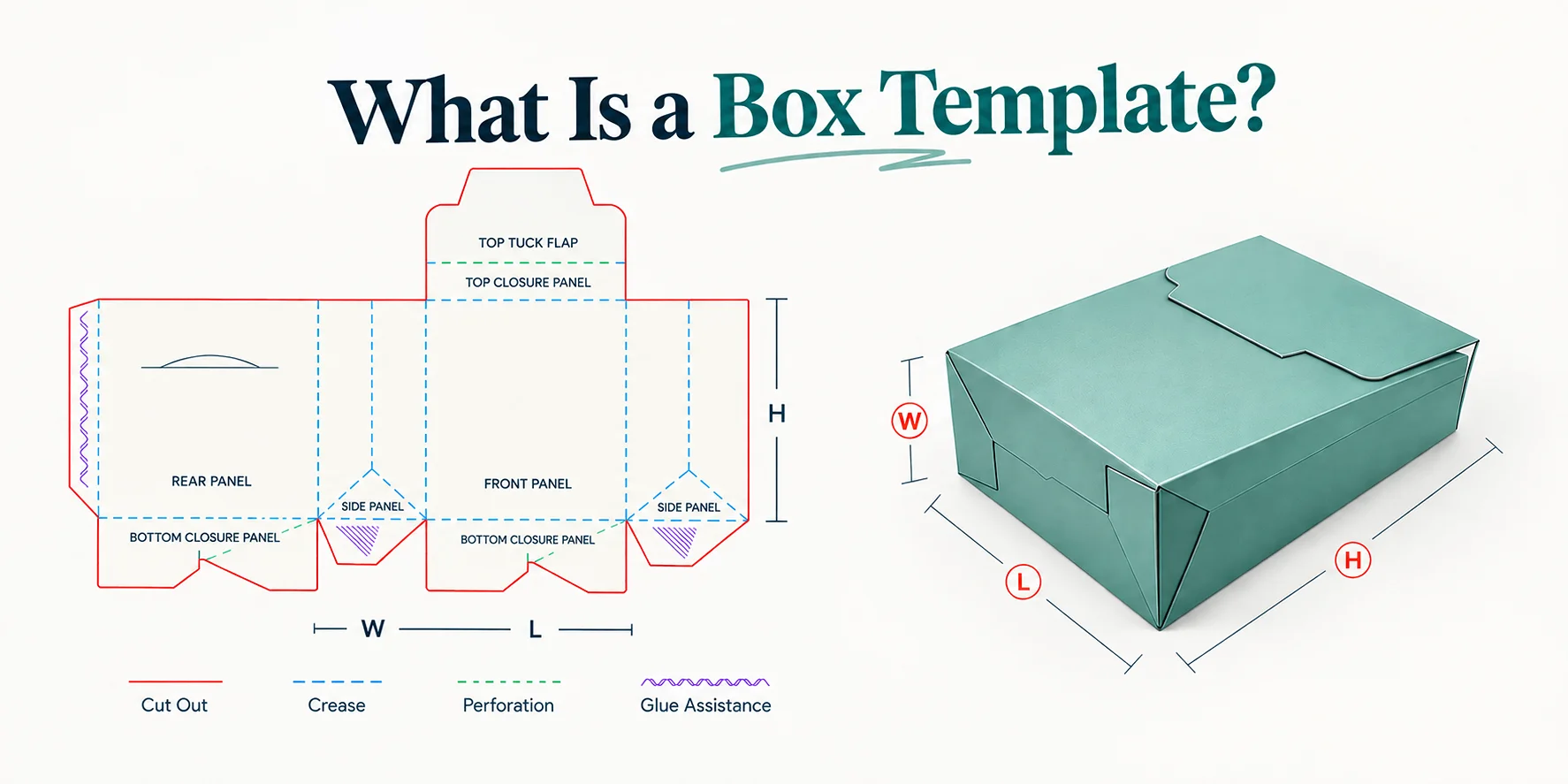
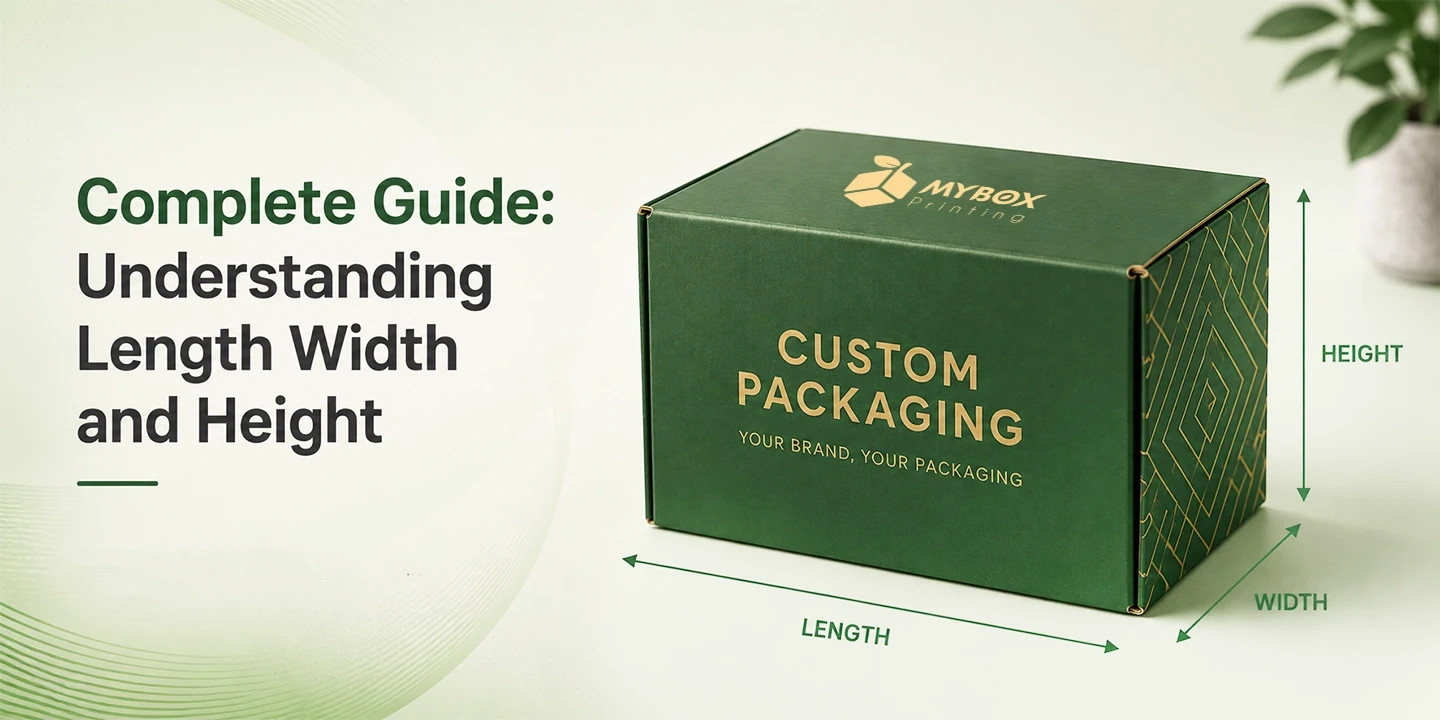
Length is the side of the box base that is the longest. It determines how the product is to be placed inside the box.
-
Width is also known as breadth and is the shortest side of the box. It is the second one to be measured in the standard dimension format.
-
Height is the vertical distance from the base of the box to the top. This determines how tall a product is and ensures there is enough room for inserts or cushions.
What Is The Standard Order For Writing Dimensions?
The packaging and other industries use the following standard format:
Length × Width × Height (L × W × H)
This order makes sure that every stakeholder involved in the process understands the specifications the same way. A different order can lead to incorrect packaging or miscalculated freight calculations. For example, if a box measures 12 x 8 x 6 inches, it should be understood as l x w x h. If someone interprets it as width x height x length and manufactures the box according to this, it can result in the product not fitting the box properly.
Dimensions in 2D vs. 3D Objects
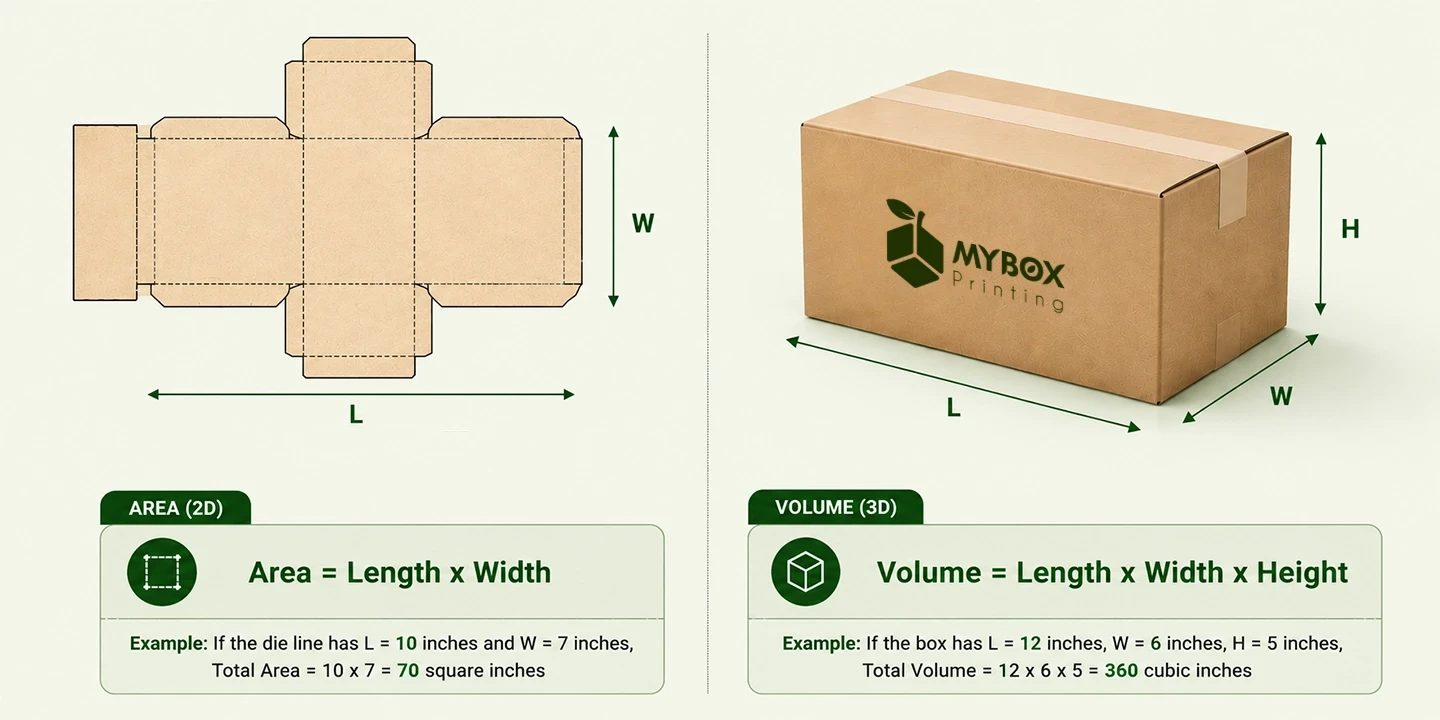
A flat product requires only length and width. A three-dimensional object adds height. This allows manufacturers and logistics providers to calculate the storage space and shipping volume. Here is the difference between the two:
| Type | Dimensions | Used For |
|---|---|---|
| 2D Objects | Length × Width | Gift cards, subscription cards, labels, stickers |
| 3D Boxes | Length × Width × Height | Cosmetic products, skincare items, glass jars and bottles, and many more |
Why Dimensions Matter: Real-World Applications
Your brand’s reputation depends on the boxes being measured correctly. Not only do they tell about the size of your product, but they also contribute to forming a brand image. Some of the reasons why these sizes matter are detailed below:

Protect the Product
The correct calculation of the product box size provides safety from breakage. For example, a bakery that uses oversized boxes for cakes can cause the frosting to crack and the layers to collapse when there is movement during the delivery.
Opportunity for Cost Saving
15% of the shipping cost is reduced each year for businesses that pay attention to the measurement of the box. This happens when the empty spaces are removed, and the box is measured in the proper format.
Reduced Material Waste
The correct size of the box helps to avoid the need for extra material like bubble wrap or packaging paper. This cuts down on the waste and reduces the packaging material costs.
Better Customer Experience
Products that are packed in boxes with correct measurements arrive in better condition at the customers’ doorstep than the ones with wrong measurements. This leads to higher customer satisfaction and fewer product returns.
Length vs Width vs Height: Understanding the Differences
All the dimensions work together to define the overall size of the product box packaging. However, each serves a different purpose in the design and manufacturing of the boxes. Here are the key differences between them:
| Box Dimensions Guide | |||
|---|---|---|---|
| Dimension | Position on the box | Direction of measurement | Role in packaging |
| Length | Longest horizontal side | Measured from one base end to the other | It determines the primary size of the box and comes first in the sequence. |
| Width | Shorter horizontal side | You can measure it from left to right across the opening. | It affects the placement of the product within the box. |
| Height | Vertical side from top to bottom | It is measured from top to bottom. | This one shows how tall the product is and how much vertical space is available. |
Calculating Volume: The L × W × H Formula
It is the amount of 3-D space contained within a box. You can calculate the total volume by multiplying all three measurements. This creates a complete cubic measurement. The formula used for calculating the volume is
Volume = Length x Width x Height
When you multiply these three values together, you get a cubic calculation in 3D space. For instance, your shipping box is 12 inches in length and 6 inches in width. It also has a height of 5 inches. The total volume for the box will be 12 x 6 x 5, which is 360.
If you have a die line of a box, you can calculate its area in the 2D format. The formula for calculating the area is
Area = Length x Width
Suppose the flat die line of a box has 10 inches of length and 7 inches of width. The total area will be 70.
Internal vs. External Dimensions: Which Should You Measure?
You created a product that is perfect and ordered custom boxes based on its sizes. The shipment comes, but the product does not fit inside. What could have gone wrong in this? The measurements of the box are made from the outside instead of the inner part. This is why businesses should understand the difference between internal and external dimensions.
Another aspect that can affect the calculation of the sizes is adding add-ons. Adding inserts can change the internal and external dimensions.
Which dimension should you measure? The answer depends on your goal. Measure the internal dimensions if you want the product to fit inside the box. For shipping cost and warehouse space, calculate the external dimensions.
Why Does It Matter?
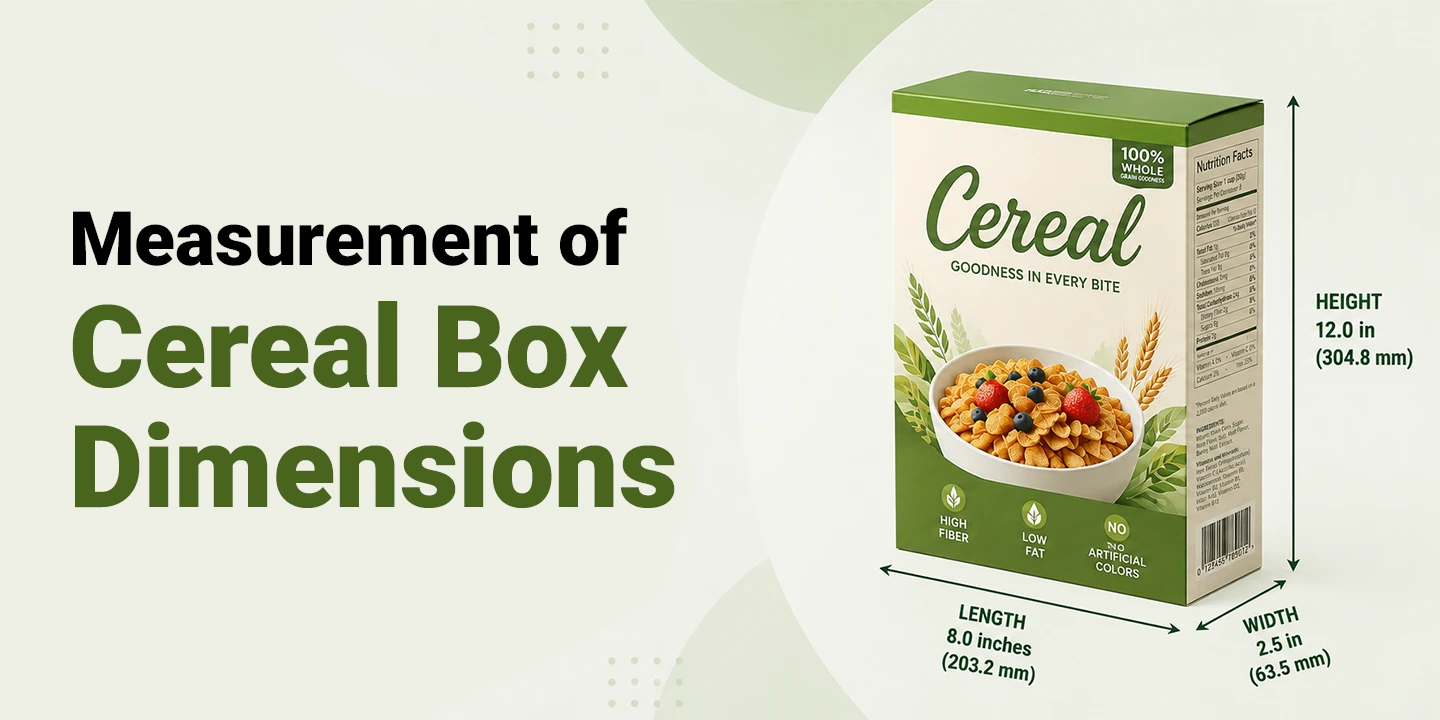
Using the correct sizes at the right stage can save you from mistakes that are costly. This also helps reduce additional costs. For instance, a cereal box may have internal dimensions 12 x 10 x 8 inches and external dimensions 12.4 x 0.4 x 8.4 inches. The difference seems small, but it can affect the overall costs, such as manufacturing and shipping.
| Interior Dimensions | Exterior Dimensions |
|---|---|
| Inside measurements | Outside measurements |
| To fit the product | For shipping & stacking |
| Usable inner space only | Includes box thickness |
| Smaller | Slightly larger |
Dimension Order Variations In Boxes: When L × W × H Doesn't Apply
Most of the industries use the standard format of lxwxh to measure dimensions. However, this is not the standard format in many cases. Sometimes the order also depends on the horizontal and vertical position of the box. The physical dimensions of the box remain the same even if the sequence may change.
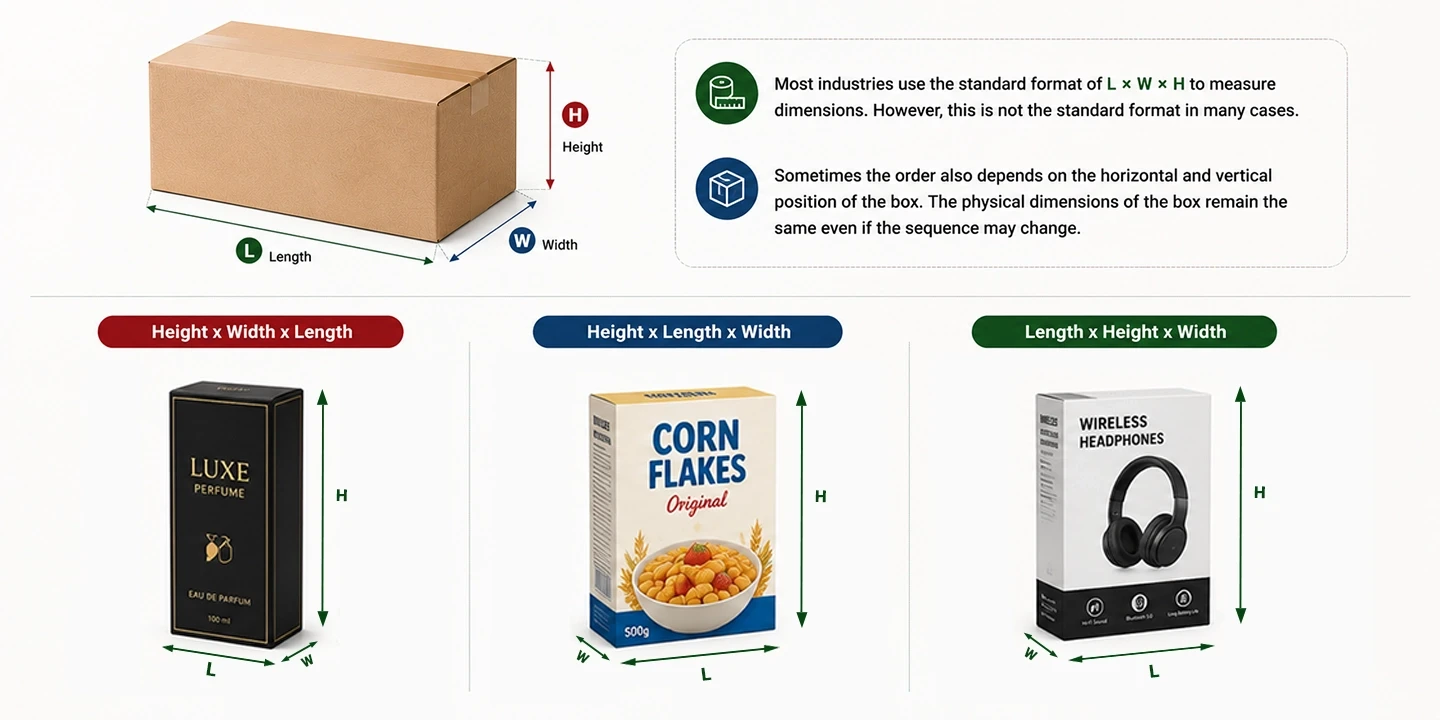
Height x Width x Length
Industries dealing with standing or vertical packaging list the height first. For example, a perfume box that stands upright can be written as H x W x L because the customers first notice how tall the packaging is.
Height x Length x Width
The side-to-side measurement is placed after the front-to-back measurement in this order. A cereal box can be listed as H x L x W to emphasize the length before the width.
Length x Height x Width
Manufacturers take measurements in this order when the length is the primary dimension. For instance, an electronic box can be measured in L x H x W, as the length is the longest.
Length vs. Width
These two are horizontal sides of a packaging box and meet at a 90-degree angle. Both these dimensions combine and give a 2D image to the object.
Width vs. Height
The width tells you how much space is available from one side to the other. The height tells you how much space is available from the bottom of the box to the top. These help in understanding whether a product will fit without being too wide or too tall.
Height vs. Length
They both work together to check how much space a product has from front to back and bottom to top. The length offers space for longer items. Height gives room for taller items.
How To Measure Length, Width, and Height: Step-by-Step Guide
A small mistake can cause oversized packaging and higher shipping costs. Hence, it is important for you to measure the length, width, and height in the correct way and check the part number width specification before finalizing the dimensions. Follow the step-by-step guide mentioned below to learn how to measure L, W, and H of a box:
Step 1. Get the measuring tool of your choice, like a measuring tape or a ruler. You can also use digital callipers to measure small boxes.
Step 2. Measure the length first. It is the longest side when viewed from the top. Place one end of the measuring tape on one end and stretch it all the way to the other end. Check the numbers on the tape and record the measurement.
Step 3. Position the tape in the horizontal direction that runs perpendicular to the length. Measure from one side to the other and record the value.
Step 4. Measure the height by running the tool from top to bottom or the other way and record the value.
How To Calculate The Volume Of The Packaging Box
Apply the formula (Volume = L x W x H) to get the volume of the box. For example, if the dimensions of a standard shipping box are 12 x 10 x 10, the volume of the box will be 1200.
Common Mistakes To Avoid When Measuring Dimensions
It seems like a simple process to calculate the length, width, and height. However, small errors can lead to incorrect packaging and shipping costs. Review the common mistakes mentioned below and learn how to avoid them before recording the dimensions for the boxes:
Wrong Interior and Exterior Measurements
One of the most common mistakes people make is to measure the wrong part of the box. Decide your purpose and then start taking the measurements. Internal measurements are used to check if the product fits inside the box. The exterior of the box can be measured to calculate the shipping costs and storage space.
Recording in Wrong Order
You might have taken the readings right but in the wrong order. This can cause wrongly manufactured packaging. Follow the standard L x W x H format to avoid the miscalculation.
Box Flap Included in Height
This is another common mistake usually done when people measure the height of a box. They include the folding flaps while recording the values. This results in incorrect height. Close the box before measuring the dimensions to avoid such mistakes.
Measuring On An Uneven Surface
The results can change when you calculate the size on a surface that is not even. Place the box on an even and flat surface and then take the measurements.
Popular Standard Box Sizes: For Every Packaging Need
Standard boxes are available for different purposes, like shipping, storage, or transportation. These standard box sizes help you choose the right size according to your product. You can also customize any size according to all your business desires. Some popular standard-size options for different purposes are given below:
Standard Box Sizes For Shipping and E-Commerce
| Box Type | Dimensions (cm) | Dimensions (inches) | Ideal For |
|---|---|---|---|
| Small Box | 10.2 x 10.2 x 10.2 cm | 4 x 4 x 4 inches | Candles, books, cosmetics, jewelry, and other small retail products. |
| — | 8 x 6 x 4 inches | ||
| Medium Box | 15.2 x 15.2 x 15.2 cm | 6 x 6 x 6 inches | Cosmetics, office supplies, mugs, e-commerce shipments, and accessories. |
| — | 10 x 8 x 6 inches | ||
| — | 12 x 12 x 12 inches | ||
| Long Rectangular Box | 30.5 x 15.2 x 15.2 cm | 12 x 6 x 6 inches | Tools, home goods, bedding, skincare sets, or retail packaging. |
| — | 20 x 20 x 12 inches | ||
| Large Box | — | 16 x 16 x 16 inches | Oversized shipments, bulk packaging, or high-volume deliveries. |
| — | 24 x 24 x 24 inches | ||
| Apparel Box | 30.5 x 25.4 x 15.2 cm | 12 x 10 x 6 inches | Perfect for clothing, fashion gifts, or branded apparel packaging. |
| Subscription Box | 22.9 x 15.2 x 7.6 cm | 9 x 6 x 3 inches | Ideal for curated gifts, monthly boxes, or collectibles like Labubu. |
Standard Box Sizes for Moving and Storage
| Box Type | Dimensions (cm) | Dimensions (inches) | Used For |
|---|---|---|---|
| Small Boxes | 41 x 30 x 30 cm | 16 x 12 x 12 inches | You can use small boxes for carrying different small products like books and canned goods. |
| Medium Boxes | 46 x 46 x 41 cm | 18 x 18 x 16 inches | Medium-sized boxes are used to carry some hefty items such as electronics and small appliances. |
| Large Boxes | 46 x 46 x 61 cm | 18 x 18 x 24 inches | Large boxes are used for bulk orders, such as different household items and linens. |
| Extra-large Boxes | 61 x 46 x 61 cm | 24 x 18 x 24 inches | Extra-large boxes are used for pillows and comforters. |
| Wardrobe Boxes | 50.8 x 50.8 x 86.4 cm | 20 x 20 x 34 inches | Wardrobe boxes are designed for hanging multiple items of clothing. |
Specialty Box Sizes
| Box Type | Dimensions (inches) | Designed For |
|---|---|---|
| Mirror Boxes | 37 x 4 x 27 | Specially designed for protecting framed pictures, mirrors, and artworks. |
| Dish Barrel Boxes | 18 x 18 x 28 | Designed to protect fragile items such as glasses and dishware. |
| Long Boxes | 60 x 8 x 8 | Designed for shipping long or retail items such as fabrics, posters, and artwork. |
| Pizza Boxes | 12 x 2 x 2 | Designed for packaging various food items, including pizzas and bakery products. |
Standard Sizes For Popular Cardboard Boxes
Before discussing the standard sizes, let’s first understand how cardboard boxes are measured. You can measure cardboard boxes by their internal dimensions. The external dimensions are not measured or cardboard boxes. Because you know that the internal and external dimensions are different from others, that’s why it also depends on the grade and fluting of the cardboard. You can measure cardboard boxes by their three dimensions. The first one is length (the longest opening dimension). The second dimension is width (the shortest opening dimension), and the third one is height (depth).
By these measurements, you can measure the box accurately for your product. If you want to add different features to a box, you need extra space in it. Then each side will increase by at least 5mm. With understanding how to measure cardboard boxes, it is now easier for you to read the exact box according to your business requirements. You can customize your box in any size, but some popular cardboard standard sizes are given below:
| Box Type | Standard Sizes (inches) | Metric Sizes (cm) |
|---|---|---|
| TV Box | 56 x 8 x 30 | 142 x 20.3 x 76.2 |
| Picture Frame Box | 41 x 6 x 32 | 104.1 x 15.2 x 81.3 |
| Crockery Box | 23.6 x 11.6 x 12 | 60 x 30 x 30.6 |
| Wine Shipping Box | 19.3 x 12.9 x 6.5 | 49 x 32.7 x 16.7 |
| Eyeliner Boxes | 0.63 x 0.63 x 5.5 | 1.60 x 1.60 x 13.97 |
| Tincture Boxes | 1.35 x 1.35 x 4.25 | 3.43 x 3.43 x 10.80 |
| Lipstick Boxes | 1.5 x 1.5 x 6.22 | 3.81 x 3.81 x 15.80 |
| Soap Boxes | 2 x 3 x 1.125 | 5.08 x 7.62 x 2.86 |
| Chocolate Bar Boxes | 2.2 x 6.12 x 0.74 | 5.59 x 15.54 x 1.88 |
| Cream Boxes | 2.5 x 2.5 x 1.94 | 6.35 x 6.35 x 4.93 |
| Mailer Boxes | 3 x 3 x 1.25 | 7.62 x 7.62 x 3.18 |
| Candle Boxes | 3 x 3 x 4.1 | 7.62 x 7.62 x 10.41 |
| Shipping Boxes | 6 x 6 x 6 | 15.24 x 15.24 x 15.24 |
Get Perfectly Measured Packaging That Promotes Your Brand
The measurements of the box are only the first step. To bring them to life with premium custom packaging is what makes your brand stand out. At My Box Printing, we make custom boxes to the exact length, width, and height that your product needs. We offer boxes in materials with high-quality printing. Our experts provide support in industries like e-commerce boxes and retail packaging. Our packaging helps get customers’ attention and builds their trust in your business. Request your free custom quote today and let us create packaging that perfectly fits your products!
Frequently Asked Questions About Right Packaging Dimensions
What are length, width, and height?
They are the measurements of the three sides of any object. The length is the longest side-to-side measurement. Width is the area from front to back of the box or any object. Height is the dimension of how tall the object or the box stands.
What is the standard order of dimensions?
The order of these dimensions can change in certain cases. However, the standard format to mention these calculations is L x W x H.
How to measure the length of a box?
Take a measuring tape and place one end on the longest side and measure from the base to the other end. Note down whatever value is shown on the tape.
How to measure the width of a box?
Start by placing one end of the tape on the front side of the box and measure from the front to the back and write down the readings shown on the tape.
How do I measure the height of the box?
You need to place the start of the tape at the top of the box and measure in a vertical position all the way down to the bottom.
What is the formula for calculating the volume of a box?
Once you have calculated the dimensions of the box, apply the following formula to calculate its volume: V = length x width x height.
Should I measure the inside or outside of the box?
Measure the inside of the box when you have to check if the product will fit correctly in the box or not. Go for the external measurements if you have to calculate the storage space or shipping cost.
What measuring tools are best for calculating length, width, and height?
One of the most reliable and easy-to-measure tools for dimensions is a measuring tape. It is easy to handle, and the values on it are easily readable.
Do packaging flaps count in the measurements?
Many users make the mistake of including the flaps calculation when recording the dimensions. The box should be completely closed when you take the measurements.
What units should I use when calculating the L x W x H?
The standard units to calculate the length, width, and height are inches. Industries use this unit across their supply chain to avoid any errors in interpretation.
Conclusion
Length, width, and height help you calculate in the packaging process and measure according to your products. However, many businesses make mistakes in the calculation for the boxes. If you want to get perfectly sized boxes made for your products, contact My Box Printing today. We offer perfect-sized boxes made that offer high quality and a premium look.